
The most frequently searched job in Pave Market Data by aerospace and defense (A&D) companies isn’t Aerospace Engineering. It’s Software Engineering, followed by Mechanical Engineering, Business Development, Hardware Engineering, and Product Management. Aerospace Engineering actually ranks ninth.
This single data point is the heart of the talent challenge the industry faces today. Aerospace and defense companies aren't just competing with Lockheed and Raytheon for engineers. They're competing with Google, Amazon, and some of the most well-funded startups in history for the same software engineers, product managers, and business development professionals those companies have long treated as their own.
A Soaring Industry Facing a Talent Crunch
The aerospace and defense sector is experiencing strong demand. A recent SIPRI report shows that global military spending reached $2.89 trillion in 2025, marking the tenth consecutive year of growth. European Union nations increased spending by 14%, while spending in Asia increased by 8% year over year. In the U.S., the overall aerospace and defense workforce has grown by over 100,000 employees—and that is still not enough to meet the talent demand.
Big players like Boeing and Airbus have reported backlogs of 14,000 aircraft, presenting aerospace and defense CEOs with an interesting challenge: it’s people, not contracts, that are hindering growth. ManpowerGroup’s Experis Mission 20230 report states that 72% of employers struggle to find skilled workers, that attrition was twice the U.S. industry average, and that nearly half of new hourly workers leave within just four months. To maintain capacity, the sector is estimated to need to add 3,800 aerospace engineers annually.
While U.S. universities produce around 140,000 engineering graduates each year, Manpower estimates that only about 60% are qualified for aerospace roles upon graduation. The current engineering pipeline is highly sought after, so these graduates are also fielding offers from other sectors that may have more competitive entry-level compensation and benefits than most defense contractors.
The Compensation Benchmarking Challenge
Looking at the Pave Market Data search queries, it is clear that aerospace and defense are also directly competing with Big Tech in their own wheelhouse. Roles like software engineers, product managers, and business development professionals are much more industry-agnostic and historically very competitive across Big Tech and adjacent sectors, where Big Tech has increasingly set the compensation baseline.
To address this, nearly 90% of U.S. aerospace and defense employers increased compensation in the last year to better position themselves to attract and retain talent. This move will help aerospace and defense employers compete, but depending on their benchmarking strategy, it may not be enough. A common approach is to benchmark against direct industry competitors, but in this type of labor and skills market, this can create unintentional blind spots. For example, it may not factor in non-sector Series B startups that offer equity, remote-first policies, and compensation packages that differ significantly from traditional defense-industry salary bands.
Pave Market Data’s Aerospace Engineering benchmarks, spanning the full job-level spectrum and developed directly from the 9,000+ companies in the dataset, are a critical first data cut. However, many aerospace and defense companies, especially those co-located with traditional technology and emerging AI companies, face an important challenge. It’s not only about benchmarking against what other aerospace and defense employers pay aerospace engineers, but also understanding how that compares with what technology companies pay software engineers, product managers, and other industry-agnostic roles.
Modernizing Aerospace & Defense Compensation Strategies
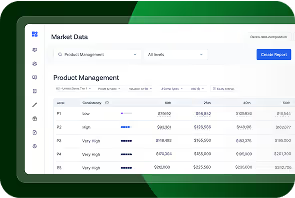
Pave Market Data provides aerospace and defense companies with cross-industry compensation insights, enabling benchmarking not only against other aerospace and defense sector employers but also against tech companies, startups, and adjacent manufacturers competing for the same talent.
The Total Rewards Portal helps employees understand the full value of their compensation and benefits, addressing attrition that often results from a lack of awareness rather than undercompensation. And the Visual Offer Letter presents offers in a format comparable to Big Tech’s recruiting experience, which is essential in an industry where 42% of manufacturing workers express interest in changing jobs within six months.

Charles is a member of Pave's marketing team, bringing nearly 20 years of experience in HR strategy and technology. Prior to Pave, he advised CHROs and other HR leaders at CEB (now Gartner's HR Practice), supported benefits research initiatives at Scoop Technologies, and, most recently, led SoFi's employee benefits business, SoFi at Work. A passionate advocate for talent innovation, Charles is known for championing data-driven HR solutions.
Frequently Asked Questions
What is the average salary for an aerospace engineer in 2026?
Mid-level aerospace engineers (P3) earn a median base salary of approximately $138,500, while senior aerospace engineers (P4) earn around $180,000, based on employer-reported data from Pave.
How does aerospace and defense compensation compare to Big Tech?
Big Tech companies typically offer higher entry-level salaries, equity packages, and remote flexibility than most defense contractors. Only about 60% of engineering graduates are qualified for aerospace roles, and those candidates frequently receive competing offers from technology firms.
What are the most in-demand jobs in aerospace and defense?
Based on Pave Market Data search activity, the most benchmarked roles by A&D companies include Software Engineering, Mechanical Engineering, Business Development, Hardware Engineering, Product Management, and Project/Program Management — with Aerospace Engineering ranking ninth.