
Your HR technology may be complicating, rather than simplifying, compensation decisions.
You know that feeling. Merit cycle season arrives and you're staring down a maze of spreadsheets, outdated market data, and approval chains held together with email threads. A top performer leaves because the talent competitor's offer was 20% above your range—a range built on survey data that was already six months stale. Your CFO wants a span of control analysis by tomorrow's board meeting, and you're still exporting from your HRIS to a spreadsheet. There's a better way—modern compensation planning tools can replace this chaos with streamlined workflows, real-time budget tracking, and elegant cycle management.
Why HRIS Comp Modules Aren't Always the Right Fit
Compensation is often the largest expense on your company's P&L. Inadequate tools can result in outdated data, unexpected costs, excessive manual work, and insufficient support from those unfamiliar with compensation strategy.
When selecting compensation technology, the key question is whether to use an HRIS add-on module or a specialized platform designed for compensation data, planning, and communication.
This decision reflects your organization's commitment to compensation strategy, not just its technical requirements.
Why Top Organizations Choose Dedicated Compensation Solutions
Recent research from Lighthouse Research & Advisory shows that while nearly half of organizations use their HCMs ' built-in compensation module, many also adopt dedicated compensation solutions. For critical pay decisions, basic functionality is often insufficient.
Dedicated compensation platforms offer three key advantages over HCM modules:
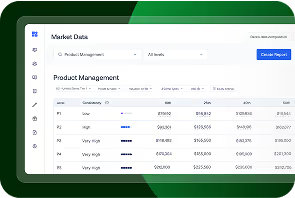
- Real-time market intelligence, not stale snapshots. HCM modules track what you're paying today—they aren't built to benchmark against external market data. Dedicated platforms, like Pave’s Market Data Pro, integrate directly with HRIS, ATS, and equity systems to deliver continuously updated benchmarks, so your pay decisions reflect current market conditions rather than survey data that's already months old.
- Multiple data sources in a single view. High-performing compensation teams use more data sources to make better decisions—blending salary surveys, HRIS-sourced benchmarks, job posting data, and more. HCM modules can't ingest and triangulate across these sources. Pave's Market Pricing brings them together with auto-smoothing and intelligent band recommendations, eliminating weeks of manual analysis.
- Purpose-built workflows for complex merit cycles. Simple annual percentage increases can be handled in HCM, but variable compensation, equity refreshes, multi-currency structures, and scenario modeling quickly exceed what those modules were designed to handle. Pave's Compensation Planning offers customizable worksheet views, flexible top-down and bottom-up budgets, and real-time cycle insights—purpose-built for how comp teams actually work.
In summary, organizations that prioritize strategic compensation decision-making do not settle for generic solutions.
AI Built for Compensation, Not Bolted On
The Lighthouse research found that AI features ranked as the number one most desired improvement among compensation technology users—and also the area of greatest dissatisfaction with current tools. The gap is clear: compensation teams want AI, but generic AI isn't cutting it.
General-purpose AI tools don't understand leveling frameworks, pay philosophy, or internal equity. In fact, the Lighthouse team tested ChatGPT for nurse compensation data and received three different answers within five minutes from the same prompt. That's not a foundation for pay decisions.
Purpose-built compensation AI—like Pave Agent—thinks like a comp analyst. It prices new roles in seconds (including emerging ones like "AI Safety Researcher" that hadn’t yet appeared in traditional surveys), flags employees outside bands with full context, and delivers board-ready insights on demand—all powered by real-time market data, confidence scoring, and audit trails.
The Hidden Risks of All-in-One HR Technology
When you opt for an all-in-one HRIS, you're betting that a system built for payroll and employee records can also deliver world-class benchmarking, equity modeling, merit cycle management, and total rewards communication. That's a big bet that rarely pays off.
Effective evaluation involves asking critical questions: Is your data sourced through real-time integrations or annual survey imports? Can the system manage all aspects of equity, including ongoing grants, unvested holdings, burn rates, and vesting structures? Will support be provided by compensation experts or a general help desk? Is the AI designed specifically for compensation, or is it a generic solution?
The responses to these questions indicate whether the platform can truly support your strategy or will require additional manual effort and workarounds.
Total Rewards Communication: The Missing Piece
Here's something most HRIS platforms ignore entirely: helping employees understand their full compensation and benefits package.
Employees consistently undervalue their pay because they rarely see the complete picture. Annual statements arrive as static PDFs, outdated on arrival. Equity remains opaque. Managers lack tools for pay conversations. And when employees sit down with a spouse or partner to evaluate a competing offer or weigh a career move, they can't clearly articulate the full value of what they already have. The result: disengaged employees who don't appreciate their total rewards—and households making major decisions with incomplete information.
Pave's Total Rewards Portal replaces static statements with an always-on, personalized experience—dynamic visualizations, interactive equity modeling, future earnings projections, and white-label branding. Managers get team views for confident compensation conversations.
How to Evaluate AI in Compensation Technology
While AI is commonly featured in sales presentations, there is an important distinction between generic AI and compensation-specific intelligence.
Purpose-built compensation AI functions at three levels. At the infrastructure level, such as AI-powered job matching that analyzes and automatically classifies roles, eliminating weeks of manual survey matching. Within workflows, auto-smoothing and Smart Flags identify risks and generate accurate pay ranges. As intelligent agents, tools like Pave Agent provide immediate answers to complex questions, such as pricing roles, conducting span-of-control analysis, and identifying compensation risks, with defensible, citable recommendations.
Choosing a Compensation Technology for Lasting Impact
The right compensation platform should serve as a force multiplier, providing confidence in your data, reducing manual work, and supporting effective communication of value to leadership, managers, employees, and candidates.
Select partners with extensive compensation expertise, not just general HR technology knowledge. Low initial costs often lead to hidden fees, limited functionality, and costly workarounds. The best solution meets your current needs and scales as your organization grows, whether you are a startup developing your first compensation strategy or a global enterprise managing equity programs in over 50 countries. From real-time market pricing to streamlined merit cycles, the right platform eliminates manual workarounds and lets your team focus on strategy.
Your compensation program should serve as a competitive advantage, not a source of administrative burden. The decision you make today will influence pay decisions for years to come. Select a partner, not just a platform.

Charles is a member of Pave's marketing team, bringing nearly 20 years of experience in HR strategy and technology. Prior to Pave, he advised CHROs and other HR leaders at CEB (now Gartner's HR Practice), supported benefits research initiatives at Scoop Technologies, and, most recently, led SoFi's employee benefits business, SoFi at Work. A passionate advocate for talent innovation, Charles is known for championing data-driven HR solutions.
Frequently Asked Questions
What is the difference between an HRIS compensation module and dedicated compensation software?
An HRIS compensation module is an add-on feature within a broader human resource information system designed primarily for payroll, employee records, and general HR administration. While convenient, these modules typically offer limited benchmarking capabilities, rely on annual survey data, and lack advanced analytics. Dedicated compensation software, by contrast, is purpose-built for strategic compensation management — offering tools such as, real-time market data, AI-powered job matching, automated market pricing, and specialized workflows for merit cycles, pay equity analysis, and total rewards communication. Organizations that need to make competitive, defensible pay decisions often find that an HRIS module alone cannot support that level of strategic depth.
Why do companies still use spreadsheets for compensation planning?
Many HR teams default to spreadsheets out of familiarity, budget constraints, or the belief that their current tools are "good enough." However, spreadsheets introduce significant risks: they're error-prone, lack real-time collaboration, create data security vulnerabilities, and can't scale with organizational complexity. Research shows that nearly half of organizations still do some manual compensation work outside their HCM system. Companies that move to dedicated compensation planning platforms typically see faster cycle times, fewer errors, and better budget visibility — freeing HR teams to focus on strategy rather than spreadsheet maintenance.
How does real-time compensation data differ from traditional salary surveys?
Traditional salary surveys collect data annually through manual submissions and are often six or more months old by the time they're published. Real-time compensation data is sourced through persistent, automated integrations with HRIS, ATS, and equity management systems, so benchmarks update continuously as pay changes occur across the market. Platforms like Pave draw from over 8,700 companies and 1.1 million employee records, publishing updated benchmarks monthly. This gives compensation teams a current view of market movement rather than a static snapshot that may already be outdated by the time it reaches their desk.
What should I look for when evaluating AI in compensation technology?
Not all AI is created equal in the compensation space. Generic AI tools don't understand leveling frameworks, pay philosophy, or internal equity — which can lead to misleading recommendations. When evaluating AI capabilities, look for three things: infrastructure-level AI (such as automated job matching that eliminates manual survey mapping), workflow-level AI (like auto-smoothing algorithms and smart risk flags), and intelligent agents that can answer complex compensation questions on demand. Purpose-built compensation AI like Pave Agent is trained to think like a comp analyst — pricing new roles in seconds, flagging pay equity issues, and delivering board-ready insights backed by real-time data with confidence scoring and audit trails.
What is a total rewards portal and why does it matter for retention?
A total rewards portal is a personalized, always-on digital experience that shows employees the full value of their compensation package — including base salary, bonuses, equity, benefits, and future earnings potential. Most employees significantly undervalue their pay because they see only their paycheck, not the full picture. Without clear visibility, employees can't accurately assess their total compensation when evaluating competing offers — and they can't share that information with a spouse or partner when making major career decisions at the kitchen table. Pave's Total Rewards Portal replaces static PDF statements with dynamic visualizations, interactive equity modeling, and white-label branding, giving both employees and managers the tools for confident compensation conversations.
Can I use both my HRIS and a dedicated compensation platform?
Yes — and many organizations do. A dedicated compensation platform is designed to integrate with your existing HRIS, not replace it. Your HRIS continues to manage payroll, employee records, and core HR administration, while the compensation platform handles the strategic layer: real-time benchmarking, market pricing, merit cycle planning, pay equity analysis, and total rewards communication. This "best-of-both" approach lets you leverage the administrative strengths of your HRIS while gaining the specialized depth required for compensation decisions.
How do I know when my organization has outgrown its HRIS compensation module?
Common signs include: spending weeks manually building pay ranges in spreadsheets, relying on benchmark data that's six or more months old, lacking visibility into pay equity or manager compression, struggling to manage complex merit cycles with multiple approval layers, and having no way to communicate total rewards to employees beyond a static PDF. If your compensation team is spending more time on workarounds than strategy, it's likely time to evaluate a dedicated compensation platform that can scale with your organization's needs — whether you have 100 employees or 50,000.