Pay transparency requirements are expanding fast. If you're leading HR at a growing company, you've likely noticed: job postings increasingly require salary ranges, candidates ask about pay bands, recruiters have new rules on how they can or cannot talk about pay, and your team wants clarity on compensation decisions.
The good news? You don't need an enterprise-grade compensation infrastructure to get this right. You need a clear starting point and a willingness to build as you go.
First, Understand What Actually Applies to You
Before building anything, understand your compliance obligations. Pay transparency laws vary by state, and remote hiring may subject you to rules in states where you lack an office.
States like California, Colorado, New York, and Washington require salary ranges in job postings—with more legislation pending. The details differ: some laws apply above certain employee counts, some require disclosure only when asked, and some mandate ranges in every posting.
Audit where your employees are. Even one remote employee in a covered state likely means those rules apply. When in doubt, consult counsel, but don't let complexity delay progress.
Build a Compensation Philosophy You Can Explain in Two Minutes
Enterprise companies have lengthy compensation philosophy documents. You’ll eventually want something like that. However, to start, just articulate how you make pay decisions—something any manager can explain to a new hire.
Answer these questions:
- Where do we aim to pay relative to the market? (50th percentile? 60th? Do you lead on equity instead of base salary?)
- What factors influence where someone lands in a range? (Experience? Performance? Scope of role?)
- How often do we review and adjust pay? (Annual cycles? Promotion-based? Ad hoc?)
- What's our approach to equity compensation? (If applicable)
Write this in plain language—a single page is enough. The goal is clarity and consistency. When an employee asks, "Why is my salary what it is?" leadership should give the same answer.
Create Ranges for Your Most Common Roles First
You don’t need a complete job architecture to be transparent. Start with the roles you hire for most and those with similar responsibilities.
For most growing companies, this typically means:
- Engineers (by level, if you have levels)
- Sales roles (AE, SDR, etc.)
- Customer success or support
- Key operational roles specific to your business
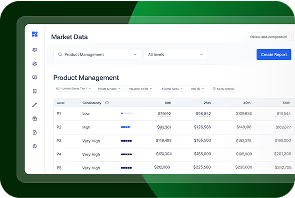
For each, set a salary range with a minimum, midpoint, and maximum. Use market data—not just your history. Tools like Pave’s Market Data Pro provide excellent coverage without getting bogged down in annual compensation surveys.
A few principles:
- Ranges should be wide enough to be useful, and narrow enough to be meaningful. A $50K spread on a $125K role is reasonable. A $100K spread is too wide to guide decisions.
- Document your logic and data for each range. You’ll need this when employees ask.
- Your first ranges won’t be perfect, and that’s fine. They’re better than having none.
Check Where Your People Actually Fall
Once you have ranges, map current employees to them. This is where things get real.
You'll likely find:
- People below the minimum. This is your most urgent problem. Employees paid below your stated range are a retention risk and also your highest compliance risk. Build a plan to bring them up, even if it takes time.
- People above the maximum. While perhaps less urgent, they still need attention. Document why, and decide if the range or situation needs adjustment.
- Clustering at odd points. If everyone’s at the bottom, your range may be aspirational. If people are scattered, pay decisions may have been inconsistent.
This process often reveals pay inequities. It’s better to discover them now than after employees compare notes.
Prepare Your Managers (Yes, All of Them)
In a smaller company, your managers are an extension of your compensation team—whether they know it or not. Every manager needs to understand:
- Your compensation philosophy and how to articulate it
- The ranges for roles on their team
- How to explain where an employee sits in the range and why
- What they can and can't promise about future pay growth
You don’t need elaborate training. A one-hour session, a written FAQ, and openness to questions will get you most of the way there. To help managers feel prepared, cover key topics in your training and FAQ such as:
- How to explain company compensation philosophy
- Ways to discuss pay ranges and where employees fall within them
- Guidance on handling tough questions about pay and fairness
- How to respond if they do not know the answer
- What to say (and not say) about future pay growth
Equipping managers with clear examples and sample answers for frequently asked questions will boost their confidence and support consistency—and consistency is key. Align on your message before managers start having pay conversations.
Start Sharing—Thoughtfully
Transparency isn’t binary. You don’t have to publish every range at once. A reasonable progression might look like this:
- Phase 1: External compliance. Post ranges on job listings as required by law. Ensure recruiters can discuss the company's compensation philosophy during interviews.
- Phase 2: Internal ranges. Share salary ranges with employees for their own role. Let people see where they fall and what growth looks like.
- Phase 3: Broader visibility. Share role ranges so employees can understand career paths and internal mobility. Explain how leveling works.
Move at a pace that matches your readiness. It’s better to do Phase 1 well than to rush to Phase 3 unprepared.
What You Don't Need (Yet)
Growing companies often stall on pay transparency, thinking they need enterprise infrastructure. But you don’t need:
- A seventeen-level job architecture
- Custom-built compensation software
- A dedicated compensation analyst
- Months of executive alignment sessions
- Perfect historical data
What you do need is clear thinking, defensible ranges, honest communication, and a willingness to fix problems as they arise. Everything else can come later.
The Bottom Line
Pay transparency is a practice, not a finish line. Start with the basics: know your obligations, explain pay decisions, build ranges for key roles, and equip your managers for transparent conversations.
Pave gives growing companies the market data, salary bands management, and communication tools to build pay transparency the right way. Request a demo to get started.

Charles is a member of Pave's marketing team, bringing nearly 20 years of experience in HR strategy and technology. Prior to Pave, he advised CHROs and other HR leaders at CEB (now Gartner's HR Practice), supported benefits research initiatives at Scoop Technologies, and, most recently, led SoFi's employee benefits business, SoFi at Work. A passionate advocate for talent innovation, Charles is known for championing data-driven HR solutions.