Manufacturing organizations are investing more than ever in their workforce—new technology, updated facilities, and AI-powered tools on the floor. And yet 72% of manufacturing workers report chronic burnout. A third are actively looking for a new job. Over half live paycheck to paycheck.
New data from UKG's frontline workforce study highlights urgent challenges in attracting and retaining frontline talent. By surveying more than 8,000 workers across 10 countries, UKG sheds light on the current employee experience of frontline workers.
The burnout numbers in manufacturing tell a specific story. 60% of manufacturing workers say they're living to work rather than working to live. 51% percent live paycheck to paycheck. Across the frontline workforce broadly, the consequences are measurable: 84% say burnout makes them less productive, 72% make more mistakes, and 41% start looking for a new job.
That's the cycle. And breaking it starts with understanding exactly why people leave.
Related reading: The New Manufacturing Compensation Playbook: Can AI and Robotics Fill the Gap?
The 5 Reasons Manufacturing Workers Leave
The study identifies a clear hierarchy of reasons why frontline workers leave, each linked to a total rewards factor. Most manufacturing organizations are not leveraging these factors effectively.
1. Low pay
Low pay remains the primary reason for turnover. However, the underlying details are more significant than the headline statistic.
Compensation concerns extend beyond pay rates to include accuracy and trust. 45% of frontline workers report that two paycheck errors would prompt them to seek new employment. In large manufacturing operations with complex payrolls, even minor errors can result in resignations.
To strengthen payroll accuracy and build employee trust, HR leaders should consider regular payroll audits, investing in robust payroll technology, and offering employees simple ways to report and resolve errors quickly.
Broader pay considerations also play a role.
2. Work schedule
The work schedule is a significant new factor, not present among the top five reasons in the previous study. In manufacturing, where schedules are often inflexible, failing to address this issue may increase turnover.
Time is a key component of an employee's perception of their total rewards or employee value proposition. Scheduling flexibility, shift swaps, and control over overtime are essential retention tools. Workers who lack control over their schedules are likely to seek other opportunities.
3. Lack of career advancement
Manufacturing workers seek clear opportunities for advancement, not just short-term assignments.
When career progression is unclear, even well-compensated employees may disengage. To address this, link pay progression to skill development and career milestones.
Compensation structures must be transparent and accessible to frontline workers to be effective.
4. Lack of recognition
Recognition is often overlooked. Frontline workers with limited interaction with leadership may feel undervalued, making recognition especially important.
Recognition programs should be meaningful, including spot bonuses and peer awards with financial value. Acknowledgment must be tied to performance and provide tangible benefits.
5. Lack of benefits
The issue often lies not in the benefits offered, but in employees' understanding of them. Many manufacturing firms provide strong benefits, yet workers may not recognize or fully understand them.
This leads to two common blind spots.
2 Things Most Manufacturing Rewards Leaders Are Missing
Workers Often Lack Visibility into Their Total Rewards
Most total rewards communications assume access to a desk, a laptop, the company intranet, and uninterrupted time, which frontline manufacturing workers and their families often lack when they receive this information.
To better reach these employees, HR leaders should consider using alternative communication channels such as digital total rewards statements, mobile apps, text messaging, or on-site kiosks. These options deliver timely, accessible information directly to workers, ensuring critical details about total rewards are available even to those without traditional workplace technology.
Health coverage, retirement match, shift premiums, paid time off, overtime earnings, and wellness benefits are all important. When considering a competing offer or expressing dissatisfaction, workers and their families should be able to clearly articulate the value of their total rewards.
If workers cannot do this, there is a significant retention risk that cannot be resolved by pay increases alone.
Providing workers with clear, accessible information about their total rewards, available on mobile devices and in shareable formats, addresses a common gap. The focus should be on fundamental questions such as the current value of their total compensation. A modern total rewards portal supports this need.
Benchmarking Practices Are Often Too Narrowly Scoped
Manufacturing HR teams typically benchmark against other manufacturers, which is logical but no longer reflects the current talent market.
Today, machine operators compare offers across industries such as fulfillment centers, healthcare, construction, and logistics. Frontline talent pools are now cross-industry, particularly in geographic areas where multiple sectors are accessible.
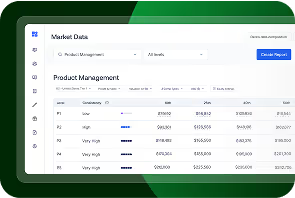
If compensation benchmarking is limited to similar industry codes, it overlooks significant competitive threats. Broaden benchmarking to include adjacent industries, considering company size and geography as well as industry. Tools such as Pave Market Data can help HR leaders compare pay and benefits across a wide range of industries and regions. Leveraging these platforms enables manufacturing rewards teams to identify pay trends, benefits offerings, and emerging talent competitors beyond traditional industry boundaries.
Since the candidate pool spans multiple industries, benchmarking should reflect this broader scope.
The Bottom Line for Manufacturing
Manufacturing's frontline workforce is more adaptable, AI-ready, and open to change than many HR leaders recognize. However, retention relies on a strong total rewards strategy.
Successful organizations focus on three priorities: clearly communicating the full value of employment to employees and their families, benchmarking pay and benefits against the broader talent market, and treating schedule flexibility, career visibility, and pay accuracy as essential components of total rewards.
The approach to talent management has evolved. Has your total rewards strategy adapted to attract, motivate, and retain talent?
Learn how Pave supports total rewards leaders in benchmarking, pricing, rewarding, and communicating.

Charles is a member of Pave's marketing team, bringing nearly 20 years of experience in HR strategy and technology. Prior to Pave, he advised CHROs and other HR leaders at CEB (now Gartner's HR Practice), supported benefits research initiatives at Scoop Technologies, and, most recently, led SoFi's employee benefits business, SoFi at Work. A passionate advocate for talent innovation, Charles is known for championing data-driven HR solutions.