In 2026, retail CHROs are less concerned about algorithms and more focused on how rapidly changing work outpaces job architecture and outdated pay structures.
These concerns are valid. McKinsey and EuroCommerce's Rewiring Retail report states that up to 75% of retail roles may change due to AI, with two-thirds of required skills shifting within five years. This change is already evident in hiring data, especially for roles that did not exist until recently.
A New Job for Retail’s New Shop Window
For two decades, retail discovery relied on search, with brands using search engine optimization (SEO) to attract customers. This model is changing rapidly. Many consumers now use AI tools such as ChatGPT, Claude, and Google's AI Overviews to discover and compare products before using traditional search. For retail and e-commerce, this represents a fundamental shift in how demand is generated.
This shift has led to the emergence of Answer Engine Optimization (AEO) and Generative Engine Optimization (GEO). AEO/GEO Specialists ensure companies appear prominently in AI-generated responses, expanding or replacing traditional SEO practices. McKinsey describes GEO as the "foundational layer" of agentic commerce and notes that marketers must now develop this skill.
This role is growing quickly. However, because it is so new, the market has not yet established its value for compensation purposes.
Pricing the AEO/GEO Specialist Role
When it comes to this job, retail HR leaders are dealing with the uncomfortable math of pricing a role that's still being priced. Pave's analysis of data from over 9,000 companies shows that the AEO/GEO Specialist role was virtually nonexistent before 2025. Hiring increased significantly in late 2025 and continues in 2026, but fewer than 0.2% of companies currently employ one.
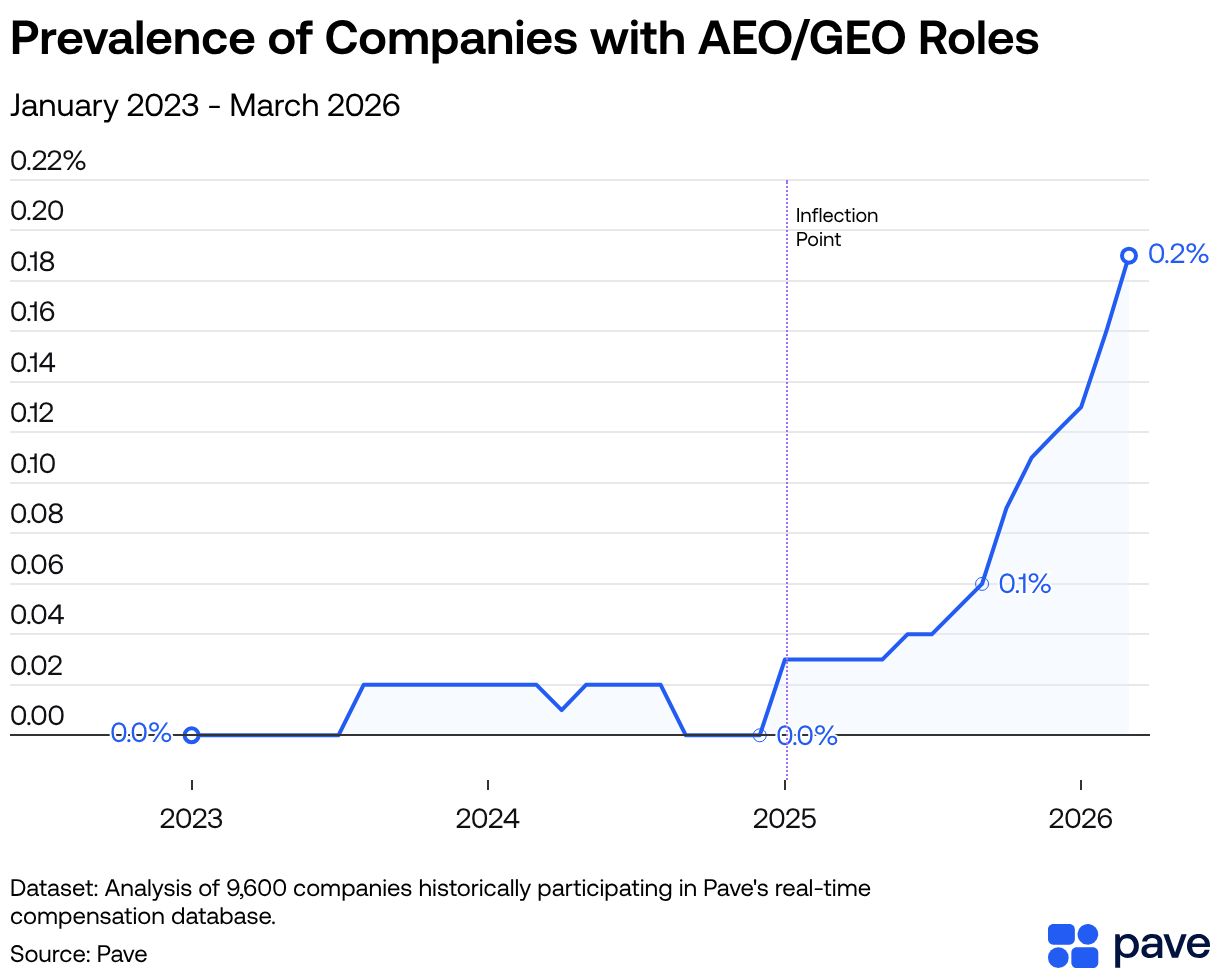
This is clearly an early-stage role. And early-stage roles often display unexpected compensation patterns.
Although it may seem that high-demand AI-related roles would command a premium, the data shows otherwise. AEO/GEO Specialists currently earn about 6.0% less than Digital Marketing professionals and 5.4% less than Social Media professionals at comparable levels. This is typical for new roles: compensation initially lags behind demand, then rises as talent becomes scarce.
Pave anticipates this pay gap will close rapidly in 2026. For HR leaders, the key takeaway is to avoid benchmarking compensation solely on current data. Setting pay bands based on today's market may leave you uncompetitive as the market evolves.
The Roles You Already Have are Changing, Too
The AEO/GEO Specialist exemplifies a broader transformation. The same report highlights how AI is redefining long-standing retail roles:
- The merchandiser moves from manual data work across fragmented systems toward strategic assortment curation and vendor negotiation.
- The stock replenisher shifts from manual inventory checks to managing and reacting to AI-generated restocking alerts.
- The warehouse manager evolves from directing human labor to orchestrating mixed fleets of people and autonomous robots.
- The marketing generalist adds GEO to the toolkit and moves from campaign execution toward strategy.
Each of these changes prompts the same question: What is the role worth now that its responsibilities have evolved? When this affects most of the workforce, ad hoc solutions are not sustainable.
4 Moves for Retail HR Leaders
1. Benchmark to the role's lifecycle, not just a historical snapshot. For emerging roles such as AEO/GEO, use established comparables like SEO, Digital Marketing, or Growth Marketing, and plan for future repricing. Incorporate anticipated pay increases into your planning rather than reacting in each cycle.
2. Revisit your pay bands. Overly narrow structures become ineffective as roles converge and transform. The report notes that functions such as UX, product, and business operations are merging. Reevaluating your bands allows for flexibility without frequent re-leveling.
3. Compensate for value and orchestration, not just activity. As AI manages execution, human roles focus on judgment, oversight, and the management of AI systems. Leading organizations now measure performance by value creation and effective orchestration. Your pay-for-performance approach should reflect this shift.
4. View reskilling as a retention strategy. The traditional "hire to retire" model is outdated as roles evolve. Leading retailers are developing talent internally, as seen with IKEA reskilling 8,500 call-center workers into interior design advisers. Reskilling preserves institutional knowledge as job requirements change.
The Real Early-Mover Advantage
Early movers benefit more from building rare, defensible expertise before the market fully recognizes its value. Retailers that get it right will not be those who react quickly to every new title or pay premium, but those who develop compensation strategies that anticipate workforce changes, plan for repricing, and use pay to support AI readiness rather than simply reflecting past structures.
As REWE's chief digital and technology officer stated in the report, companies that succeed with AI become "a more data-driven company, and that cultural asset is something competitors cannot simply buy." The compensation strategy contributes to this asset. In 2026, the key question for retail HR is not whether these roles are important, but whether you are positioned ahead of the curve or trying to catch up.

Charles is a member of Pave's marketing team, bringing nearly 20 years of experience in HR strategy and technology. Prior to Pave, he advised CHROs and other HR leaders at CEB (now Gartner's HR Practice), supported benefits research initiatives at Scoop Technologies, and, most recently, led SoFi's employee benefits business, SoFi at Work. A passionate advocate for talent innovation, Charles is known for championing data-driven HR solutions.