Over the last several months, there has been an increase in headlines about white-collar jobs being eliminated by AI and automation. Data continues to show that this is more than a short-term trend, as seen across marketing roles, for example. However, an under-covered story is how these AI disruptions are also creating new opportunities for the roles that build and maintain the infrastructure that enables AI.
As more companies deploy advanced AI systems, there is an increasing need for professionals to ensure that the data feeding it is AI-ready, that the AI decisions are accurate and auditable, and most importantly, that the systems are secure.
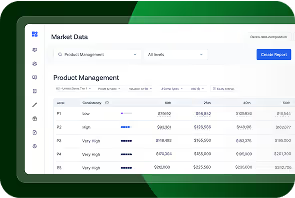
These are the jobs showing up in the hiring data right now, as seen in Pave’s Hot Job Index, which scores and ranks jobs from −100 (cooling fast) to +100 (heating fast). This analysis of hiring momentum and role prevalence across 9,000+ companies shows how organizations are redesigning their workforces to meet the evolving AI landscape.
Let’s take a look at this trend in more detail.
Data Governance: The Foundation AI Runs On
AI tools are only as effective as their inputs. As the saying goes, "garbage in, garbage out." As companies move from AI pilots to production deployment, they’re discovering they need teams to own the data frameworks, taxonomies, and quality standards that will make AI outputs consistently reliable. These are the Data Governance professionals—and until recently, most companies didn’t have one.
This isn’t about cleaning up the data for a single project or just answering “Is this data correct right now?” Data Governance teams are answering more challenging questions and ongoing questions: “Who owns this data, how often does it refresh, and can a system unfamiliar with the dataset interpret it?” AI is driving organizations to treat this as a permanent discipline rather than an ad hoc project.
The data tells an interesting story: these roles were essentially flat or in decline for most of 2024 and 2025. Then something changed and prevalence jumped from 0.012% to 0.022% between July 2025 and January 2026—nearly doubling in two quarters. That inflection point tracks directly to when large-scale enterprise AI shifted from pilots to production.
This increased demand is also showing up in pay premiums at the more senior levels of the job function. While entry-level new hires are paid at nearly the same rate (99.9%), more senior team members command a premium—Career/Senior and Staff/Expert are being paid a premium of 10.9.5% and 110.4%, respectively. This shows that companies may not be building junior talent pipelines; instead, they are placing greater value on the most experienced professionals in this space.
Internal Audit: AI’s Reality Check
While Data Governance focuses on AI inputs, the role of the Internal Audit professional is about AI accountability. Companies deploying AI systems that directly make or heavily influence real decisions (hiring, asset allocation, customer escalations, etc.) are increasingly required by boards and regulators to ensure the accuracy and defensibility of those decisions. This means the Internal Audit role is no longer focused just on financial decisions, but managerial ones as well.
Whether a legal or management obligation, the job-to-be-done is to ensure that the company can reconstruct how an AI-influenced decision was made and whether it followed the standard operating procedures (SOPs) for that type of decision making.
The data shows a nearly uninterrupted upward trend in prevalence from 0.057% to 0.089%—a 56% increase since October 2023. The hiring data is more dramatic: after a mild trough in late 2024, hiring accelerated sharply through 2025, reaching 0.129% in Q1 2026—well above the trend line of 0.112%. That gap between actual and trend is the signal that the urgency around this role shifted.
Current pay premiums further reinforce this: Career/Senior hires command 113.8%, suggesting real competition for experienced internal auditors specifically.
Information Security Operations: Guarding a Bigger Perimeter
Long seen as business-critical in the SaaS era, Information Security Operations (InfoSec) takes on new importance as AI creates new opportunities and vulnerabilities. This job was already in high demand, but the boom in AI adoption has launched this demand to new heights.
Every business system is vulnerable to attack by bad actors. AI increases that potential risk and introduces new attack methods, such as prompt injection, model poisoning, and data exfiltration through AI interfaces. There is also a security risk of internal teams building “shadow agents” or using unsanctioned AI tools deployed without the necessary security review. InfoSec Operations are the teams that monitor and respond to these types of threats, and their continued growth shows that companies are taking this seriously.
Indeed, the Hot Jobs score of 69 is driven more by prevalence growth. Prevalence is up 71% from 0.14% to 0.24%, with a sharp acceleration in late 2025 that mirrors the pattern in both Data Governance and Internal Audit. Hiring data doesn't show the same surge, indicating that companies are building these teams steadily over time rather than reactively.
The Bigger Picture
While these are three different roles within three different functions, there's a consistent pattern in the data: all three were relatively flat or modest through 2023 and into 2024, and all three show a meaningful acceleration in the back half of 2025. That timing maps cleanly to the shift from experimentation to large-scale deployment in enterprise AI, showing that these jobs are heating up as a direct result of the AI boom.
The software engineer role is unlikely to go away anytime soon, but the near-term AI job creation is primarily outside of those engineering roles. The AI builders are getting the most attention, but the people who maintain AI’s data feeds, check its decision making, and defend it against attacks and vulnerabilities are the roles showing up most clearly in the hiring data.
AI is still in the early innings, but the more decisions a company moves into AI systems, the more oversight those systems will require. As AI becomes more autonomous and regulation matures, the demand for the people who govern, audit, and secure these systems should continue to climb. The data is already showing it.

Charles is a member of Pave's marketing team, bringing nearly 20 years of experience in HR strategy and technology. Prior to Pave, he advised CHROs and other HR leaders at CEB (now Gartner's HR Practice), supported benefits research initiatives at Scoop Technologies, and, most recently, led SoFi's employee benefits business, SoFi at Work. A passionate advocate for talent innovation, Charles is known for championing data-driven HR solutions.