
Key Takeaways
- Compensation analysis tools replace static surveys and fragmented spreadsheets with connected, real-time market data across roles, levels, and geographies.
- Core tool categories include benchmarking, pay equity analysis, compensation planning, and analytics, each solving a distinct problem in the compensation workflow.
- Running a compensation analysis follows five steps: gather internal data, set benchmarks, analyze pay equity, build salary bands, and report findings.
- Pay transparency legislation now spans more than a dozen states, making defensible salary ranges a compliance requirement, not just a best practice.
- The right platform integrates directly with your HCM, ATS, and equity management systems, eliminating manual data transfers and keeping benchmarks current.
Pay moves faster than spreadsheets can keep up with. If you're searching for compensation analysis tools, you're probably trying to benchmark pay, price roles, and build salary bands with real-time, market-backed data you can actually defend. The right tool replaces guesswork with credible ranges, ones you can explain to leadership, compare across locations and levels, and apply without undermining internal equity.
Picture a refresh for Senior Engineers in Austin and Toronto. You need market cuts by level, current compensation from your HCM, open requisition data from your ATS, and equity refresh guidelines, all aligned before you brief the business.
Tools that connect directly to those systems turn scattered inputs into a single source of truth, letting you model scenarios, defend recommendations, and walk into leadership conversations with confidence rather than caveats.
Why Use Compensation Analysis Tools?
Spreadsheets break at scale. Managing compensation data across hundreds of roles, multiple geographies, and shifting market conditions creates lag, inconsistency, and risk that manual processes can't contain. Compensation management software centralizes your data and connects it to live benchmarks, so your salary ranges reflect current market reality rather than last year's survey.
The stakes have also risen. Pay transparency laws now require defensible salary ranges in job postings across more than a dozen states, and that list keeps growing. Candidates compare offers in real time, and employees share salary data openly. If your compensation philosophy rests on outdated benchmark data, you'll lose talent to organizations that move faster.
Categories of Compensation Analysis Tools
Understanding these categories helps you match tools to your team's actual needs, rather than buying features you'll never use.
Benchmarking tools
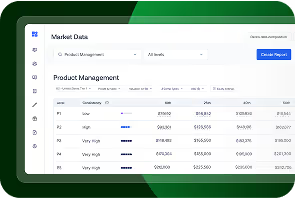
Salary benchmarking tools answer the core question: "Are we paying competitively for this role, in this location, at this level?" The key differentiator across tools is data freshness. Traditional survey-based benchmarking can lag market movements by months. Real-time benchmarking tools pull from direct, persistent connections to companies' HCM, ATS, and equity management systems, so the benchmarks reflect where compensation actually stands right now, not where it stood when a survey closed.
Pay equity tools
Pay equity tools analyze your compensation structures to identify statistical disparities by gender, race, or other protected categories. They surface pay gaps and model remediation scenarios, helping you demonstrate fair compensation practices to employees, candidates, and regulators. Many compensation management platforms include basic pay equity reporting, though the depth of statistical analysis varies considerably across tools.
Compensation planning tools
Compensation planning software manages the workflows around merit cycles, promotions, and budget allocation. Instead of distributing spreadsheets to managers and hoping the numbers come back clean, planning tools let you model scenarios, set guardrails, and track approvals in one controlled environment. A platform that pulls live benchmarks directly into your planning workflow means you're budgeting against current market data, not figures from last quarter's survey export.
Analytics tools
Analytics tools aggregate your compensation data into reports and dashboards that surface trends, outliers, and risks. They answer questions like: "What's our compa-ratio distribution by department?" or "Which roles are most exposed based on where we're positioned to market?" Most modern platforms include analytics features, but depth and flexibility vary considerably, so it's worth pressure-testing this in any evaluation.
How to Do a Compensation Analysis
Running a compensation analysis follows a logical sequence: gather data, establish benchmarks, identify gaps, build structures, and report findings. Each step builds on the previous one, and skipping steps creates blind spots that undermine your conclusions.
Step 1: Gather your compensation data
Pull your internal compensation data from your HCM or payroll system: base salary, bonus targets, equity grants, job titles, levels, locations, departments, and tenure. Clean data matters here; inconsistent job titles or missing level designations will create noise throughout your analysis. If your data lives in multiple systems, a compensation management tool that connects directly to your HCM and ATS saves hours of manual reconciliation before you can even begin.
Step 2: Set benchmark data
Match each role to external market data through accurate job matching, comparing your internal roles to standardized job descriptions in your benchmark source. The quality and currency of that source shape everything downstream. Real-time benchmark data drawn from direct connections to peer companies gives you current salary ranges by location, level, and company stage, without waiting on a survey cycle to close. For specialized or executive roles, you may need to triangulate across multiple sources to get ranges you can defend.
Step 3: Analyze pay equity gaps
Compare internal pay across demographic groups to identify statistical disparities by gender, race, and age within comparable roles and levels. Pay equity analysis goes beyond simple averages. You need to control for legitimate factors like tenure, performance, and geography. If your organization is subject to pay equity audits or operates in regulated industries, documented methodology is essential, and a structured pay equity audit process makes that documentation far more defensible.
Step 4: Build salary bands
Use your benchmark data to construct salary bands for each role and level. A typical salary band includes a minimum, midpoint, and maximum, with the midpoint often set at the market median or your target percentile. Your compensation philosophy determines where you position bands relative to market, at the 50th percentile for cost control, or the 75th to compete aggressively for talent. Salary bands create consistency and give managers clear guidelines for offers and adjustments.
Step 5: Report insights
Synthesize your findings into reports that leadership can act on. Highlight roles where you're significantly below market, equity gaps that need remediation, and the budget implications of proposed changes. Effective reports recommend actions, not just numbers. A platform built for pricing jobs and building compensation bands generates the visualizations and audit trails that make complex pay data accessible to finance partners and executives alike.
Choosing the Right Tool for Your Team
Your choice depends on company size, budget, and which problems feel most urgent.
For startups and growth-stage companies, a platform with free access to real-time benchmarks lets you set competitive offers and build foundational pay ranges without committing to a full enterprise contract. As you scale, pay equity and planning capabilities become increasingly critical, especially when merit cycles involve dozens of managers making decisions simultaneously.
Mid-market and enterprise teams typically need a platform that spans multiple workflows: benchmarking, job pricing, planning, and communication. At this stage, direct integration with your HCM, ATS, and equity management systems becomes non-negotiable.
Manual data transfers introduce the kind of errors that undermine confidence in your recommendations right when you need leadership's trust most. Ask vendors about data refresh frequency, because annual survey cycles feel slow when you're competing in a market that moves month to month.
Measuring Success After Implementation
Adopting new compensation analysis software should produce measurable improvements. Track metrics tied to the problems you were solving: compa-ratio distribution and salary band compliance for benchmarking tools; merit cycle time, manager exceptions, and budget variance for planning software; pay equity gap closure and remediation rates for equity tools.
Qualitative signals matter too. Are compensation decisions happening faster? Do managers trust the data you provide? Can you answer executive questions about pay ranges without scrambling? A successful implementation shifts compensation from a bottleneck to a capability.
Make Every Pay Decision One You Can Defend
Pave brings benchmarking, planning, and total rewards communication together in one platform, powered by real-time data from thousands of connected companies. If you're ready to move away from guesswork and toward pay decisions you can defend with confidence, explore what the Pave platform can do for your team.

Pave is a world-class team committed to unlocking a labor market built on trust. Our mission is to build confidence in every compensation decision.
Frequently Asked Questions (FAQs):
What tools does a compensation analyst use?
Compensation analysts typically use compensation management software that can benchmark compensation, price jobs, manage pay ranges, run merit cycles, and communicate total rewards in one end-to-end workflow. They also rely on real-time market data and job-matching capabilities to compare roles accurately and support pay decisions with confidence.
How can compensation professionals run a compensation analysis?
A compensation analysis starts by matching roles to the market, then reviewing internal pay against real-time benchmarks to identify gaps. From there, you price jobs, build or adjust pay ranges, and use planning workflows to model changes before communicating total rewards to employees.
What are the main methods used to collect compensation data?
Compensation data is commonly collected through employer-reported market datasets, compensation surveys, internal HR and payroll records, and third-party aggregated benchmarks. Many teams blend multiple sources and analyze them together to improve coverage and decision quality.
How can you benchmark compensation effectively?
To benchmark compensation, you first align each job to the right market match, then compare current pay to market benchmarks using up-to-date data. After reviewing results, you set or refine pay ranges and use those ranges to guide offers, adjustments, and merit cycle decisions.
What is the difference between compensation planning and compensation management software?
The terms are often used interchangeably, but compensation planning software typically refers specifically to merit cycle workflows, while compensation management software is a broader term that may also include salary benchmarking and pay range management. Many modern platforms handle both in a single system.