Key Takeaways
- Executive compensation benchmarking is a process, not a one-time data pull. It requires a defined peer group, a clear compensation philosophy, and a data source that reflects current market conditions.
- Compensation surveys and benchmarking are related but distinct. Surveys are one type of data input. Benchmarking is the broader process of comparing your pay practices to the market.
- For organizations approaching executive compensation for the first time, the peer group and percentile target are two of the most consequential decisions.
- The best executive compensation benchmarking software combines real-time data with filters for company stage, industry, and geography, and covers both cash and equity.
Executive compensation decisions carry more weight than almost any other pay decision an organization makes. Getting them right requires more than a rough sense of what the market pays; it requires a structured process, the right data, and a clear understanding of how different information sources compare.
This guide walks through what executive compensation benchmarking is, how it differs from a compensation survey, how to approach it for the first time, and what to look for in the software tools that support the process. Whether you're building your first executive pay structure or refining an existing one, the frameworks here apply.
What Is Executive Compensation Benchmarking?
Executive compensation benchmarking is the process of comparing what your organization pays, or plans to pay, its executive team against what peer companies pay for equivalent roles.
The goal is to establish whether your compensation is competitive enough to attract and retain leadership talent, appropriately structured relative to your company stage and philosophy, and defensible to your board, investors, and, in some cases, regulators.
According to Pave's dataset, on average, 21% of a company's total personnel spend goes to executive base salary alone. That figure makes the stakes of getting executive pay wrong, in either direction, considerably higher than most other compensation decisions.
Executive benchmarking differs from employee-level benchmarking in a few important ways. The data pool is smaller, exceptions are more common, and the process involves more qualitative judgment alongside the quantitative inputs.
Compensation Survey vs. Executive Compensation Benchmarking: What's the Difference?
This distinction matters because the two terms are often used interchangeably, which can lead to confusion about what data you actually have and how current it is.
A compensation survey is a structured data collection instrument. Organizations submit their pay data, the survey provider aggregates and anonymizes it, and the results are published, typically on an annual cycle. Surveys have historically been the primary way companies access external pay data, and they remain a legitimate input for benchmarking.
Their limitation is timing: by the time a survey is published, the underlying data may be six to twelve months old, and the submission process itself requires significant manual effort.
Executive compensation benchmarking is the broader process of evaluating how your pay practices compare to the external market. A compensation survey can be one input in that process, but benchmarking also draws on real-time integrated platforms, proxy disclosures ((the public filings in which public companies report executive pay to the SEC), peer group analysis, and compensation consulting expertise.
The distinction matters most when market conditions are moving quickly. A survey snapshot from last year may not reflect what your actual competitors are offering today.
For executive roles in particular, where a single hire can significantly affect the company's trajectory, relying solely on annual survey data introduces meaningful risk. The more complete approach combines survey data, where it exists, with real-time benchmarks filtered to your relevant peer group.
How to Approach Executive Compensation Benchmarking for the First Time
For founders and early-stage company leaders approaching executive compensation benchmarking without a dedicated total rewards team, the process can feel opaque. The following steps provide a practical starting point.
Step 1: Define the Roles You're Benchmarking
Start by listing the executive titles you need to price. Be specific. "Head of Engineering" and "Chief Technology Officer" may seem equivalent, but they often carry different pay expectations depending on the company stage, team size, and reporting structure. Use consistent, standard role definitions so your benchmarks are comparable across data sources.
Step 2: Identify Your Peer Group
Your peer group is the set of companies whose pay practices you're measuring against. For early-stage companies, the most relevant peers are typically defined by industry, funding stage, revenue, headcount, and geography. Peer groups for executive benchmarking typically include between 10 and 25 companies, small enough to stay relevant, large enough to yield statistically meaningful data.
For a deeper guide to building a peer group, explore this breakdown of executive compensation peer groups.
Step 3: Select Your Data Source
Choose a benchmarking tool or data source that covers your peer group well. For private companies, this means looking for platforms with strong venture-backed and early-stage data, not just public company disclosures. Confirm that the data is recent, ideally updated in real time or at a minimum refreshed within the last six months, and that sample sizes for each role are sufficient to draw conclusions.
Step 4: Set Your Percentile Target
Your percentile target reflects your compensation philosophy. A company targeting the 75th percentile is choosing to pay above most of its peers, which may be appropriate if equity is limited or if the role is critical and competitive. A company targeting the 50th percentile is aiming at the market midpoint. There is no universally correct answer, but you need to make a deliberate choice before pulling benchmarks; the data has no anchor.
Step 5: Look at Total Compensation, Not Just Base Salary
Executive compensation packages combine base salary, annual or performance-based bonus, equity in the form of options or restricted stock units, and benefits. Evaluating base salary alone will give you an incomplete and potentially misleading picture.
Make sure your benchmarks include total cash, total equity, and ideally total compensation so you're comparing full packages, not components in isolation. Pave's overview of total cash, total compensation, and total rewards is a useful reference for understanding how these layers work together.
Step 6: Review and Refresh Regularly
Executive pay markets move. A benchmark that was accurate when you set a package twelve months ago may no longer reflect what the market is paying today. Build a regular review cadence, at a minimum annually and ideally tied to board cycles, so your compensation stays calibrated as the market shifts.
At most companies with a board, executive compensation decisions require compensation committee approval. If you're navigating that process for the first time, this guide to compensation committee meetings covers how to structure and present your recommendations.
What to Look for in Executive Compensation Benchmarking Software
The right executive compensation benchmarking software reduces the manual work of data gathering and gives you more confidence in the outputs. When evaluating tools, the following features matter most.
- Real-time data: Annual survey data introduces a lag between when the market moves and when you can see it. Platforms that collect data through direct integrations with HRIS and equity management systems can reflect current conditions rather than a point-in-time snapshot.
- Peer group filters: Executive benchmarking requires the ability to filter by company stage, capital raised or revenue, industry, geography, and headcount. Without these filters, you're comparing against a general market that may not reflect your actual competitive set.
- Role-level granularity: Broad categories like "C-suite" or "VP-level" are not precise enough for executive benchmarking. Look for platforms that distinguish between specific titles and provide sufficient sample sizes for each.
- Cash and equity coverage: Many tools cover base salary well, but have weaker equity data. For executive roles, equity is often the largest component of total compensation. Confirm that the platform you're evaluating includes equity benchmarks alongside cash.
- Ease of workflow: For compensation leaders and founders who aren't pulling executive benchmarks every week, ease of use matters. A platform that requires significant setup time or manual data wrangling for each query creates friction that reduces how often the data actually gets used.
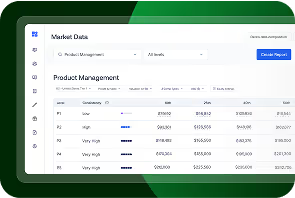
Pave's Market Data covers executive compensation benchmarks across cash and equity, with filters for company stage, industry, and geography, built on real-time data from more than 9,000 integrated companies. For teams that need more advanced workflows, Market Pricing adds job pricing, range building, and scenario modeling on top of the benchmark layer.
Building Confidence in Every Executive Pay Decision
Executive compensation benchmarking is a discipline that requires the right peer group, current data, and a clear philosophy about where you want to position relative to the market. Done well, it gives compensation leaders and founders the confidence to make offers, set ranges, and defend pay decisions to boards and employees alike.
Pave's Market Data gives compensation teams real-time access to executive benchmarks across cash and equity, with the filtering tools to compare against the peers that actually matter. Explore Pave Market Data →

Pave is a world-class team committed to unlocking a labor market built on trust. Our mission is to build confidence in every compensation decision.
Frequently Asked Questions
What is the best executive compensation benchmarking software?
The best executive compensation benchmarking software combines real-time data, strong peer group filtering, and coverage of both cash and equity. The most important criteria are data recency, sample size at the executive level, and the ability to filter by company stage, industry, and geography. Platforms that rely on annual survey submissions introduce lag that can make benchmarks misleading in a moving market. Pave's Market Data provides real-time executive benchmarks across more than 9,000 companies, with filters designed for the nuances of executive compensation.
How should a founder approach executive compensation benchmarking for the first time?
Start by defining the roles clearly, building a relevant peer group based on your stage and industry, and choosing a percentile target that reflects your compensation philosophy. Then pull benchmarks that cover total compensation, not just base salary, and make sure the data source is recent enough to reflect current market conditions. For a step-by-step walkthrough, see the guide above. Pave's executive compensation overview is also a strong starting point for founders new to the process.
What is the difference between a compensation survey and executive compensation benchmarking?
A compensation survey is a data collection instrument, typically published annually, where organizations submit pay data that is then aggregated and made available to participants. Executive compensation benchmarking is the broader process of comparing your pay practices to the external market. Surveys are one valid input in that process, but benchmarking can also draw on real-time platforms, proxy disclosures, and peer group analysis. The key difference is that surveys provide a periodic snapshot, while benchmarking, done well, is an ongoing process informed by the most current data available.
What executive roles should be included in a benchmarking exercise?
Most organizations benchmark the full C-suite, including CEO, CFO, CTO, Chief People Officer, and Chief Revenue Officer, plus VP-level roles in key functions. The specific roles depend on your org structure, but the general principle is to benchmark any role where compensation is set individually rather than through a standard band, and where a misaligned offer could affect your ability to hire or retain the person.
How often should executive compensation be benchmarked?
Most compensation teams review executive benchmarks at a minimum once per year, often tied to board approval cycles. However, for roles that are actively being recruited or where the market is moving quickly, more frequent checks are appropriate. Platforms with real-time data make ad hoc benchmarking considerably easier than tools that require a formal survey cycle.