
The shortage of robotics talent is the primary constraint on Japan’s most significant industrial opportunity in decades. Compensation leaders can take specific actions to address this challenge.
Japan’s Ministry of Economy, Trade, and Industry has set a target of capturing 30% of the global general-purpose robotics market by 2040. That share is worth roughly $111 billion, with annual growth of about 70%. It’s a bold goal for a country that helped invent industrial robotics, and a necessary one given the demographics. McKinsey’s analysis is direct about the catch: the next wave of robotics won’t be won by hardware alone, and Japan currently lacks the AI, software, and engineering talent to win it.
This is as much a compensation issue as a technological one. US manufacturers have used pay strategies to attract robotics talent, and similar approaches are relevant in Japan, though the stakes are higher and the market presents unique challenges.
Why This Moment Matters for Japan’s Robotics
The demographics explain the urgency. Japan’s working-age population has been shrinking since the early 1990s. The 2026 census recorded the steepest population decline on record, with more than three million residents lost in five years and nearly 30% of citizens now 65 or older. McKinsey projects the available worker pool will fall by 15 million over the next two decades. Robots aren’t a productivity upgrade in that context; they’re how the economy keeps functioning. Demand is most acute in the hardest-hit sectors, including elder care, where the market is expected to grow from about $650 billion in 2023 to $780 billion by 2040.
Japan’s challenge is not a lack of ambition, but that its hardware leadership has not translated to the current robotics landscape. In 2010, five of the world’s top ten industrial-robotics companies were Japanese. Today, no Japanese company ranks among the top ten humanoid suppliers, and Japan files about 1,100 humanoid patents annually compared to China’s 7,700.
Manufacturing robot density in Japan declined from first to fifth globally between 2009 and 2024. Its share of global industrial robot production decreased from 54% in 2015 to 29% in 2024. Focusing solely on traditional industrial robots is insufficient, as that segment is growing at only about 3% annually.
Value is shifting toward AI, software, data, and large-scale deployment. McKinsey questions whether Japan can quickly enough leverage its hardware expertise to lead in these areas—a question that depends on talent.
The Human Factor Holding Back Robotics
McKinsey dedicates a full section of its analysis to strengthening the talent pipeline, with a particular emphasis on compensation. The main finding is clear: Japan has fewer engineers and physical-AI experts than China or the United States. To compete, OEMs and suppliers require more talent in embedded software, firmware, and AI, as well as effective integration of these hires into organizations designed for a previous era.
Three primary challenges emerge, each linked to compensation:
First, the workforce is aging and shrinking. Births are at their lowest level since 1899, and the working-age cohort is shrinking every year. McKinsey projects the available worker pool will fall by 15 million over the next two decades. Fewer young engineers are entering the workforce, which raises the cost of both hires and departures.
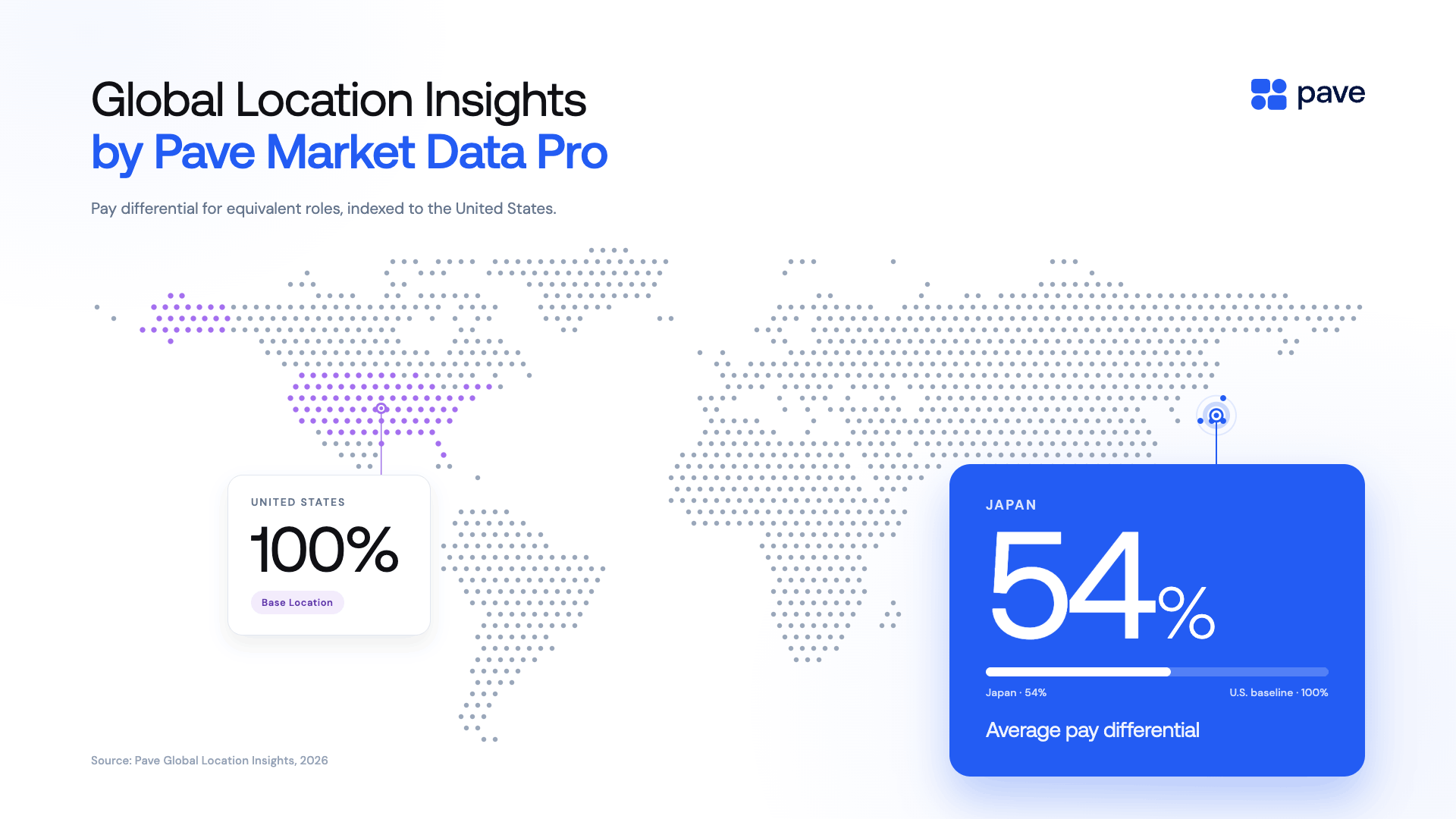
Second, Japanese compensation is no longer competitive. McKinsey notes that salaries in Japan are typically less competitive than before. According to Pave’s Global Location Insights, compensation in Japan is about 54% of the US benchmark for equivalent roles. While this gap may benefit local hiring, it poses a significant challenge when recruiting globally mobile robotics engineers who can easily compare offers across markets. Also worth noting, in 2026 Japan awarded the lowest median merit raise among the 23 countries we track, at just 1.8%, compared with the US median of 3.6% and India's 9.9%.
Finally, equity is increasingly important for Japanese employers and employees. McKinsey recommends that Japanese firms offer equity and stock-option packages to top talent, but cautions that firms “may encounter some difficulties if the same options are not offered to other employees.” Differentiated pay can create pay equity and transparency issues, posing a design challenge that can hinder modernization if not managed effectively.
Three Actions for Japanese Compensation Leaders
For companies developing pay strategies to pursue this opportunity, three actions are most important. These lessons can be applied to many organizations, but the current labor, economic, and business pressures in Japan make their application particularly urgent.
1. For some roles, benchmark to international compensation standards
Outdated domestic salary averages are insufficient to attract globally mobile candidates, who will be critical for filling advanced technology roles such as robotics and AI. Compensation expectations for robotics engineers are now set in markets such as San Francisco and Shenzhen, not only Tokyo.
Pave’s Market Data Pro shows how high it sits. Base salaries climb steeply with level, from a 25th-to-75th percentile range of about $81,000 to $103,000 at P1 to $188,000 to $273,000 at P6. The senior individual contributor band, P5, runs roughly $187,736 to $243,726.
These figures represent the benchmarks Japanese OEMs must meet. Real-time, level-specific data enables companies to price roles competitively based on what candidates can command globally, addressing the Japan-versus-global gap before losing potential hires.
2. Bridge potential pay gaps with equity
The 54% compensation gap can potentially be addressed through equity. If cash compensation is below US benchmarks, equity is an effective way to close the gap for globally mobile candidates, who already expect such packages.
In the US, equity is now common well below executive levels. Pave benchmarks indicate that a P5 robotics engineer receives approximately $589,000 in new-hire equity at the 50th percentile and nearly $894,000 at the 75th percentile. P6 hires exceed $1.46 million at the 75th percentile. Candidates evaluating opportunities in Tokyo compare total compensation packages to those in Shizen or Silicon Valley, making equity a key factor in competitive offers.
Equity is no longer a foreign concept in Japan. Median stock-option grant ratios at Japanese firms have reached record highs, the government is easing stock-option tax rules, and established manufacturers are adopting these practices. For example, Dai Nippon Printing will introduce a stock-based compensation plan for employees in fiscal 2027, positioning it as an investment in its workforce. For robotics companies, equity both bridges the cash gap when recruiting from the US and other AI hubs and aligns scarce talent with long-term value creation.
The fairness concerns McKinsey highlights can be addressed with appropriate tools. Modeling equity structures, testing for internal fairness, and clearly explaining pay differences by role and skill are essential. This approach allows companies to offer stock options to scarce AI talent while maintaining a transparent and defensible compensation framework for all employees.
3. Create global-ready total rewards
McKinsey recommends that Japanese firms adopt a global-native approach by combining local and international talent, expanding overseas, and using mergers, acquisitions, and acqui-hires to address skill gaps. Each of these strategies raises complex questions about pay leveling and equity across regions and currencies, such as how to integrate acquired engineers into compensation bands and maintain competitive offers across multiple markets.
Additionally, McKinsey suggests that Japanese companies establish independent 'sandbox' units with their own success metrics and compensation packages to accelerate progress. These units require access to market data, compensation banding, and equity modeling from the outset, without legacy corporate processes. A unified compensation platform transforms this from a manual task into a managed process.
Aligning Robotics and Talent Strategies
Japan possesses the hardware, supply chains, and domestic demand to lead in general-purpose robotics. However, it currently lacks the necessary talent, and attracting talent depends on competitive compensation.
The companies that succeed will not necessarily be those with the largest automation budgets. Success will come to those who align talent and technology strategies with compensation packages that are attractive enough to secure top engineering talent. While automation addresses labor quantity, attracting specialized talent is a compensation challenge that can be addressed directly.
Learn how Pave’s real-time benchmarking data can help you competitively price robotics and engineering roles in every market where you operate.

Charles is a member of Pave's marketing team, bringing nearly 20 years of experience in HR strategy and technology. Prior to Pave, he advised CHROs and other HR leaders at CEB (now Gartner's HR Practice), supported benefits research initiatives at Scoop Technologies, and, most recently, led SoFi's employee benefits business, SoFi at Work. A passionate advocate for talent innovation, Charles is known for championing data-driven HR solutions.

Frequently Asked Questions
How big is Japan's robotics opportunity?
Japan's Ministry of Economy, Trade, and Industry has set a target of capturing 30% of the global general-purpose robotics market by 2040, a share worth roughly $111 billion. The overall market is projected to grow from under $1 billion in 2025 to about $370 billion by 2040, expanding around 70% annually.
Why is Japan struggling to compete for robotics and AI talent?
Japan has fewer engineers and physical-AI experts than either China or the United States, and its pay has fallen behind. Pave data show that compensation in Japan runs at roughly 54% of the US benchmark for equivalent roles, and in 2026, Japan awarded the lowest median merit raise among the 23 countries tracked—just 1.8%, versus 3.6% in the US and 9.9% in India.
How much do robotics engineers earn?
Per Pave Market Data Pro, robotics engineer base salaries range from about $81,000–$103,000 (25th–75th percentile) at the P1 level to $188,000–$273,000 at the P6 level. The senior individual contributor band (P5) ranges from roughly $187,736 to $243,726. Equity adds substantially more: a P5 hire receives about $589,000 in new-hire equity value at the median and nearly $894,000 at the 75th percentile.
Can equity help Japanese companies compete for global talent?
Yes. Because Japanese cash compensation structurally trails US benchmarks, equity is one of the most effective ways to close the gap for globally mobile candidates—and it's a fast-growing trend in Japan, with stock-option grant ratios at record highs and manufacturers like Dai Nippon Printing rolling out employee stock-based compensation plans.
What should compensation leaders do to win robotics talent?
Three actions: benchmark pay against the global market rather than domestic averages; use equity to close the cash gap with globally mobile candidates; and build offer and pay structures that hold up across markets and currencies. The companies that win aren't the ones with the biggest automation budgets—they're the ones that treat talent and technology strategy as the same problem.