.avif)
Key Takeaways
- Job architecture creates clarity through structured role families and levels, helping employees and managers navigate responsibilities, scope, and progression consistently across the organization.
- Effective frameworks balance consistency with flexibility, supporting both management and technical career paths while maintaining fair leveling and pay equity.
- Market-based benchmarking strengthens compensation decisions, aligning job levels with real-time market data to ensure competitive, equitable pay at scale.
- Successful implementation requires time and leadership commitment, typically taking three to six months with executive sponsorship, clear communication, and change management to drive adoption.
What happens when a company grows from 50 to 500 employees without a clear structure for roles and pay? Confusion, misaligned compensation, and rising turnover quickly follow.
A job architecture framework brings order by organizing roles, defining career paths, and creating consistent, scalable compensation systems.
Job architecture connects roles across departments through clear job families and levels, enabling fair pay bands and transparent progression. By grouping similar roles, setting levels based on scope and impact, and aligning them with market-based compensation data, companies can scale with confidence.
What Is a Job Architecture Framework?
A job architecture framework is a structured system that organizes all positions within a company into a logical hierarchy. It defines how roles relate to each other and establishes clear pathways for career advancement. This framework goes beyond simple org charts by incorporating job families, career levels, competencies, and compensation bands into one cohesive system.
Core Components of Job Architecture
The foundation starts with job families, which group similar roles together based on the type of work performed. All engineering roles fall under one family, while sales positions form another. Within each family, job levels indicate seniority and scope of responsibility, typically ranging from entry-level to executive positions.
Job profiles and descriptions provide detailed information about responsibilities, required skills, and performance expectations for each role. These comprehensive documents capture what each position contributes to the organization.
Architecture frameworks organize roles both horizontally and vertically. Horizontally, roles are grouped by function or job family. Vertically, the framework establishes levels within each family, showing progression from individual contributor roles through management to executive positions.
Job Architecture vs. Job Leveling: Key Differences
Understanding the distinction between job architecture and job leveling is critical for implementation success.
Job leveling focuses on creating a hierarchy within a single job family. It ranks positions like Software Engineer I through Staff Engineer based on experience, skills, and impact. This vertical structure helps organizations establish clear progression paths and compensation bands within one discipline.
Job architecture encompasses the entire organizational structure. It includes all job families, shows how different families relate to each other, and ensures consistency across the organization.
The key difference: job leveling is tactical and function-specific, while job architecture is strategic and organization-wide. Companies need both, but job architecture provides the overarching framework that makes job leveling effective across all departments.
Why Job Architecture Matters for Growing Companies
As companies scale, informal roles and pay structures stop working. Without job architecture, growth often leads to title inflation, pay inequities, and unclear reporting lines.
Employees need clarity on responsibilities and advancement, managers need consistent promotion and pay guidelines, and HR teams need a framework to maintain fairness as headcount increases.
Creating Consistent Job Structures
Job architecture standardizes job titles and levels across the organization. A “Senior Manager” role should reflect comparable scope and responsibility, regardless of department.
Achieving consistency requires reviewing existing roles and adjusting titles when needed. Clear communication helps employees understand that these changes support fair pay and transparent career paths.
Supporting Career Progression Paths
Job architecture makes career progression clear and measurable. Employees understand what skills, impact, and experience are required to move to the next level, reducing subjective promotion decisions.
Modern frameworks support multiple paths, including management and specialist tracks. Employees can advance based on strengths, such as technical expertise, without being forced into people management roles.
Essential Components of Modern Job Architecture
Modern job architecture has evolved beyond simple hierarchies and job titles. Today's frameworks incorporate dynamic elements, including skills-based competencies, flexible career paths, and data-driven job evaluation methodologies.
Job Families and Functions
Job families group roles that share similar characteristics, skills, or purposes within the organization. A typical technology company might have families for engineering, product management, sales, marketing, and operations.
The key to effective job family design lies in balancing specificity and flexibility. Too many families create unnecessary complexity, while too few fail to capture important distinctions. Most organizations aim to structure job families in a way that reflects meaningful differences in work while remaining simple enough to manage consistently across the business.
Common job family categories include:
- Technical: Engineering, Data Science, IT Operations
- Product & Design: Product Management, UX/UI Design, Research
- Go-to-Market: Sales, Marketing, Customer Success
- Operations: Finance, HR, Legal, Facilities
- Leadership: Executive team members across functions
Job Levels and Career Tracks
Job levels create the vertical structure within each family, typically ranging from four to eight levels depending on organizational size and complexity. Each level represents a significant step in responsibility, impact, and compensation:
- Entry levels (1-2): Execute defined tasks and learn systems and processes
- Mid levels (3-4): Work independently, mentor junior team members, and own projects
- Senior levels (5-6): Drive strategic initiatives, influence organizational direction, and lead teams
- Leadership levels (7-8): Set vision, lead large organizations, and impact company strategy
Career tracks provide pathways for advancement that align with employee strengths and interests. The traditional management track remains important, but many organizations now offer parallel technical or specialist tracks. This dual-track approach recognizes that organizations need deep expertise as much as good managers.
Competencies and Skills Frameworks
Modern job architecture increasingly incorporates competency frameworks that define the skills, behaviors, and knowledge required at each level. These frameworks connect job levels to actual capabilities, making promotion criteria more objective and transparent.
Skills-based approaches emphasize what employees can do rather than just their job titles. This shift reflects how work actually gets done in today's organizations, where project teams form and reform based on needed skills rather than rigid departmental structures. Organizations using skills-based architecture report better talent mobility and more accurate succession planning.
Building Your Job Architecture Framework, Step by Step
Constructing a job architecture framework requires systematic planning and execution. The process typically takes three to six months for mid-sized companies, though larger organizations might need a year or more to complete comprehensive implementation.
Starting with clear project charter and stakeholder alignment proves critical for success. Leadership must understand and support the initiative, as job architecture changes often require difficult decisions about titles, reporting relationships, and compensation.
Step 1: Define Roles and Job Families
Begin by cataloging all existing roles and grouping them into logical families. This process often reveals surprising inconsistencies—similar roles with wildly different titles or identical titles used for completely different work.
Key activities include:
- Extracting all current job titles from HRIS systems
- Interviewing managers to understand actual responsibilities
- Researching market standards for job family structures
- Grouping roles into 15-25 families based on function and skills
- Validating family definitions with leadership and employees
Data from HRIS systems provides the starting point, but the real work involves conversations with managers and employees to understand what people actually do. Defining job families requires balancing market practices with your unique business model and culture.
Step 2: Conduct Job Evaluation and Leveling
Job evaluation determines the relative value of different roles within the organization. Traditional point-factor systems remain popular, but many companies now use market-based approaches that rely on external benchmarking data.
Leveling assigns each role to an appropriate tier within its job family. This process requires careful calibration to ensure consistency across families.
Key leveling factors include:
- Scope of responsibility and decision-making authority
- Required experience and expertise
- Impact on business outcomes and revenue
- Complexity of problems solved
- Leadership and influence (formal or informal)
- Budget or resource management responsibilities
Create level definitions that describe expectations for each factor at each level. These definitions become the standard for all promotion and leveling decisions going forward. Modern platforms, like Pave, can streamline this process with AI-assisted job matching and market intelligence.
Step 3: Align Compensation Ranges
Once roles are leveled, align each level with market-based compensation data. This ensures your pay ranges are competitive while maintaining internal equity across similar levels.
Compensation alignment involves:
- Benchmarking each level against market data from relevant peer companies
- Establishing pay range minimums, midpoints, and maximums for each level
- Setting range spreads (typically 40-50% from minimum to maximum)
- Creating overlap between adjacent levels to allow for experience differentiation
- Reviewing ranges quarterly to ensure they remain competitive
Modern compensation software provides real-time market data from thousands of companies, allowing you to benchmark accurately without relying on outdated salary surveys.
Step 4: Create Detailed Job Descriptions
Write comprehensive job descriptions for every role in the architecture. These descriptions need to capture not just current responsibilities but also how roles might evolve as the organization grows.
Effective job descriptions include:
- Job family and level
- Key responsibilities and deliverables
- Required skills and experience
- Success metrics and performance expectations
- Career progression pathways
- Compensation range
Instead of starting from scratch, teams can generate initial drafts based on similar roles in the market, then customize them for specific needs.
Step 5: Implement and Communicate
Implementation requires careful change management. Employees need to understand what's changing, why it matters, and how it affects them personally.
Communication strategy should include:
- Leadership messaging explaining the business rationale
- Manager training on how to discuss changes with their teams
- Individual conversations with employees whose titles or levels change
- FAQs addressing common concerns about compensation and career paths
- Ongoing forums for questions and feedback
Transparency about the process builds trust, even when individual employees don't agree with every decision.
Job Architecture Common Challenges and Solutions
Organizations implementing job architecture frameworks encounter predictable challenges. Understanding these obstacles helps teams plan effective mitigation strategies.
Resistance to Title Changes
Employees often resist title changes, even when new titles more accurately reflect their work. Some view title changes as demotions, while others worry about external perception.
Solutions:
- Communicate that titles will change, but compensation won't decrease
- Emphasize the benefits of clearer career paths and fair pay
- Focus on total rewards, not just job titles
Inconsistent Leveling Across Functions
Maintaining consistency across different job families proves challenging. Engineering managers might level their team members differently from sales managers.
Solutions:
- Create cross-functional calibration committees
- Use clear, objective leveling criteria
- Benchmark levels against market data, not just internal comparisons
- Review leveling decisions across functions for consistency
Managing Pay Equity Issues
Job architecture often reveals pay inequities that developed organically. Some employees might be underpaid relative to their new level, while others might be overpaid.
Solutions:
- Create correction budgets to address critical underpayment
- Implement pay increase caps for overpaid employees
- Use merit cycles to gradually align pay with ranges
- Be transparent about the timeline for correcting inequities
Keeping Architecture Current
Job architecture frameworks can become outdated as organizations evolve. New roles emerge, markets shift, and business strategies change.
Solutions:
- Review architecture annually, making updates as needed
- Monitor market data continuously for compensation changes
- Create governance processes for adding new roles or levels
- Use compensation management platforms that provide real-time market data
Measuring Job Architecture Success
Effective job architecture implementation requires clear metrics to track progress and demonstrate value.
The metrics below represent common areas organizations measure, along with typical improvement ranges observed after successful implementation. These benchmarks serve as guidelines—your specific targets should be based on your organization's baseline performance and strategic priorities.
Compensation Efficiency
Organizations often track improvements such as:
- Reduction in pay equity gaps over time
- Increase in employees positioned within target pay ranges
- Decrease in time spent on annual compensation planning cycles
Talent Management
To evaluate workforce impact, companies may measure:
- Changes in internal promotion rates
- Reduction in time-to-fill for open roles
- Decreases in voluntary turnover
Employee Experience
Job architecture clarity can also be assessed through:
- Employee survey results measuring understanding of career paths
- Reduction in compensation-related complaints or grievances
- Increased manager confidence in promotion and pay decisions
Operational Efficiency
Process-related improvements may include:
- Shorter compensation review cycles
- Greater consistency in job titles and leveling across departments
- Faster HR response times to compensation-related inquiries
Organizations that define baseline metrics before implementation can quantify ROI over time and continuously refine their frameworks.
Implementing Job Architecture with Modern Technology
Job architecture improves how organizations hire, pay, and develop talent by creating clear role structures, levels, and progression paths that scale with growth.
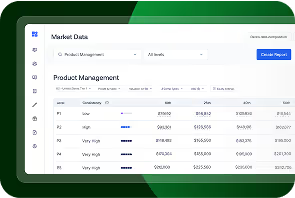
Effective implementation requires accurate data and the right tools. Pave’s compensation platform provides real-time benchmarks from 8,700+ companies, AI-assisted job matching, and automated market pricing toolsto help teams build and maintain job architecture without manual processes.
As work evolves, flexible and skills-based frameworks matter more than ever. Companies that invest in modern job architecture are better positioned to compete for talent, maintain fair pay practices, and support clear career growth.
Request a demo to learn how you can use Pave to build and implement a scalable job architecture framework.

Pave is a world-class team committed to unlocking a labor market built on trust. Our mission is to build confidence in every compensation decision.
Frequently Asked Questions
What is a JTBD framework?
The Jobs-to-Be-Done (JTBD) framework focuses on understanding customer motivations for buying rather than product features. In compensation management, JTBD helps HR teams understand what employees and managers truly need from compensation systems—transparency, fairness, or career progression clarity—rather than just focusing on software features.
What are the seven levels of the job title hierarchy?
The standard job hierarchy progresses through Entry-Level (Intern/Assistant), Junior/Associate (Analyst), Mid-Level (Specialist/Team Lead), Senior/Lead (Senior Analyst/Manager), Director/Principal, Executive/VP (Vice President), and C-Suite (CEO/CFO/CTO). Each level represents increasing responsibility and organizational impact with corresponding pay bands.
What are the five principles of job design?
The five core principles are span of control, accountability, responsibility, autonomy, and influence. These principles ensure each position has clearly defined boundaries for decision-making authority, ownership of outcomes, independence in task execution, and the ability to impact organizational goals.
What are the seven steps in job analysis?
The seven steps include reviewing job requirements, researching similar market positions, identifying required outcomes, reviewing efficiencies, determining necessary skills and training, defining salary bands, and continuously evolving roles as needs change. Modern compensation platforms streamline these steps through AI-assisted job matching and real-time market data.