
Key Takeaways
- A compensation cycle is the annual process that guides how an organization plans, allocates, approves, and communicates pay decisions.
- Strong cycles begin with clear objectives, market benchmarking, and performance data, and end with transparent employee communication.
- Budget discipline requires modeling scenarios early and building separate pools for merit increases, promotions, and equity adjustments.
- Pay equity audits should be integrated into the cycle, not treated as a separate annual event.
- Moving beyond spreadsheets to purpose-built platforms reduces errors, improves consistency, and creates a defensible audit trail.
A compensation cycle is the annual rhythm that connects business strategy to individual pay decisions. It covers market benchmarking, performance reviews, merit increases, bonuses, equity adjustments, and manager communication, and it gives Total Rewards leaders the structure to make those decisions consistently, defensibly, and on budget.
Without a structured cycle, pay decisions become reactive. Increases get approved inconsistently. Budget overruns catch finance off guard. High performers leave before anyone identifies the gap.
{{mid-cta}}
Why Compensation Cycles Matter
Compensation is typically the largest line item on a company’s budget, making a structured, repeatable process essential to managing it effectively.
A well-run compensation cycle helps organizations allocate those dollars strategically, directing funds toward roles that drive growth, addressing pay gaps before they become legal issues, and ensuring the total rewards package stays competitive in the market.
The external environment raises the stakes further. Pay transparency laws in many states now require employers to disclose salary ranges in job postings, which means compensation decisions are increasingly visible to candidates, employees, and regulators. A well-documented cycle gives Total Rewards leaders the data and process evidence to back up every decision, which matters when leadership, legal, or employees ask questions.
Insights from Pave’s Merit Cycle State of the Union highlight how organizations are evolving their compensation cycles, with a growing focus on structured planning, clearer allocation strategies, and stronger alignment between pay decisions and business performance.
Set Clear Objectives for Each Cycle
Before gathering data or modeling numbers, define what success looks like for this year's cycle. Objectives align stakeholders early and give you a framework for evaluating tradeoffs when budget and priorities collide.
Common objectives include retaining high performers, closing pay equity gaps, staying competitive in high-demand job markets, or controlling costs during lean periods. These priorities shift year to year depending on business conditions and talent strategy. An early-stage company might prioritize competitive offers to attract talent, while a more mature organization might focus on internal equity and retention.
Document your objectives and align with leadership before the cycle begins. If executives understand that closing gender pay gaps is a stated priority, targeted adjustments in the budget become easier to defend rather than harder to explain.
Benchmark Roles Against Market Pay
Market benchmarking answers a question every leader needs to answer with data, not instinct: Are we paying what the market pays for similar work? Without this step, organizations overpay in some areas and lose talent in others without understanding why.
Start by matching internal jobs to benchmark data. This matching process is more consequential than most people realize. A "Senior Engineer" at your company might align with a "Staff Engineer" in survey data, depending on scope and responsibilities. Poor matches produce poor recommendations.
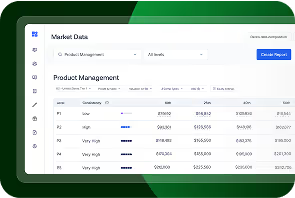
Traditional survey providers offer robust datasets but often lag real-time market movement by six to 12 months. Modern platforms connect directly to HRIS and ATS systems to surface more current data. Pave pulls real-time compensation data from 8,700+ companies, giving teams a clearer picture of what the market actually pays today rather than what it paid last year.
Benchmark at least annually, though high-turnover roles or competitive markets may warrant quarterly checks.
Gather Performance Review Data
Performance data connects pay to contribution. Without it, merit increase and promotion decisions rest on anecdote rather than evidence, which creates both equity risk and manager credibility problems.
Your performance review process should close before compensation planning begins. Rushing reviews to meet a compensation deadline produces inconsistent ratings that cascade into inconsistent pay decisions. Build your calendar backward from your target payout date to protect time for calibration.
Calibration sessions are where consistency gets enforced. One manager's "exceeds expectations" carries a different standard than another's without a structured conversation to align them. Bring leaders together to discuss ratings and compare examples before those inputs flow into compensation recommendations.
Pull performance data directly into your compensation planning system. When ratings live in one system and planning happens in spreadsheets, errors compound, and audit trails break down.
Plan Merit Increases and Promotions
This is where strategy meets math. Merit and promotion decisions need to balance individual performance, internal equity, market position, and budget constraints simultaneously.
Most organizations use a merit matrix that maps performance ratings to increase ages, adjusted for position in the range. An employee rated "exceeds expectations" who already sits at the top of their salary band will typically receive a smaller increase than someone with the same rating who sits below the midpoint. This logic protects internal equity while keeping spending within range.
Promotions require separate treatment. A promotion carries a title change, expanded scope, and a meaningful pay increase. Conflating merit increases with promotion raises creates credibility problems with managers and employees alike.
Model scenarios before finalizing recommendations. What does giving top performers five percent instead of four percent do to the total budget? What is the cost of accelerating promotions for your highest-potential employees? Pave's Compensation Planning module lets compensation teams model these scenarios in real time, with budget impact updating as individual recommendations change.
Ensure Total Rewards Alignment
Base pay is one element of a total rewards package that also includes benefits, equity, bonuses, and retirement contributions. Compensation cycle planning should account for how changes to one element affect the perceived value of the whole.
If employer retirement contributions are decreasing next year, higher base pay may be needed to maintain your overall value proposition in the market. If you're rolling out an equity refresh program, that affects how aggressively you need to position cash increases.
This coordination matters operationally, too. Without it, one team commits to equity grants while another plans base increases that together exceed the approved budget. Align across HR, finance, and business leaders early so all rewards programs work together.
Employees consistently underestimate the value of their benefits, especially when compensation is communicated in fragmented ways. A clear statement that captures base pay, bonus targets, equity value, and other rewards reduces the likelihood that someone leaves over a misunderstanding of what they're actually earning. Pave's Total Rewards portal makes it easy to communicate that full picture at scale.
Involve Stakeholders in Decisions
Managers own recommendations for their direct reports. They have the closest view of who is delivering, who is a flight risk, and who is ready for a promotion. Give them clear guidelines, budget parameters, and decision-support tools.
The Total Rewards team provides oversight, ensuring consistency across the organization. Flagging outliers, identifying pay equity concerns, and ensuring recommendations align with policy is not about overriding managers. It's about catching problems before they become harder to fix.
Finance approves the overall budget and monitors spending. A finance partner who understands the rationale behind a request is more likely to find flexibility than one who only sees a larger number. Bring them into planning discussions early.
Executives sign off on final recommendations, especially for senior roles or significant adjustments. Keep them informed throughout, so approval meetings are quick confirmations rather than discussions that should have happened weeks earlier.
For a practical guide to preparing managers for merit cycle season, Pave's resources walk through the frameworks that make manager conversations more consistent and defensible.
Communicate Compensation Changes Effectively
Manager enablement is the most important lever in compensation communication. Most managers struggle with these conversations, not because the decisions are wrong, but because they lack the language and preparation to explain them well. Equip them with talking points, FAQs, and clear guidance on what they can and cannot share before conversations begin.
Timing discipline matters equally. Changes should be communicated before they appear in paychecks, within a tight window across the organization, so information stays consistent. Schedule the communication rollout as deliberately as you schedule the planning process itself.
For a broader framework on how to approach communication, Pave's guide to compensation conversations covers how HR teams can build manager confidence and consistency at scale.
Measure Success and Track Equity
After the cycle closes, evaluate whether it achieved its stated objectives. This phase informs next year's approach and gives Total Rewards leaders concrete data to report business impact to leadership.
Start with operational basics. Did you hit your budget? Did the cycle complete on time? Did managers submit recommendations by their deadlines? These metrics surface process problems before they compound.
Then examine outcomes. Compare post-cycle pay positioning to market data. Did you move closer to your target percentile? Track offer acceptance rates and voluntary turnover, segmented by performance rating. If top performers are still leaving at elevated rates, merit increases may be one factor to examine.
Pay equity audits belong inside this review, not as a separate annual event. SHRM research found that while 61% of HR leaders conduct pay audits to identify inequities, only 54% do so annually.
That gap between intent and cadence is where disparities widen undetected. Analyze pay differences across gender, race, ethnicity, and other protected characteristics, controlling for legitimate factors like role, level, location, and tenure. When gaps are identified, build a remediation plan with a specific budget and timeline, and document the analysis, findings, and corrective actions. That documentation protects the organization legally and demonstrates a process that holds up to scrutiny.
Pave's Equal Pay Day research, drawn from nearly 700,000 employee records, shows how even small role-adjusted gaps in base salary and equity compound meaningfully over time. It is a useful benchmark for understanding what your own analysis should be looking for.
Run a Better Cycle With the Right Tools
Spreadsheet-based compensation cycles introduce version control problems, increase error rates, and make audit trails nearly impossible to maintain. Purpose-built platforms automate the time-consuming parts so the team can focus on strategy. They route approvals automatically, flag recommendations that fall outside guidelines, and maintain a complete history of every change and decision.
Pave connects directly to your HRIS, ATS, and equity systems, creating a single source of truth for all compensation data with real-time benchmarks built in. Managers can see how their recommendations compare to the market without waiting for the compensation team to run reports, which speeds up the cycle and improves the quality of recommendations at the source.
Build a Compensation Cycle That Works Year After Year
A well-run compensation cycle transforms pay from a source of organizational friction into a strategic advantage. It gives Total Rewards leaders a defensible process, gives managers clear guidelines, and gives employees confidence that pay decisions follow consistent rules.
The fundamentals stay consistent regardless of company size or stage: set objectives, benchmark against market, gather performance data, plan increases thoughtfully, align total rewards, manage budget, involve stakeholders, communicate clearly, and measure results.
Pave's platform connects every step of that process in one place, from Market Data Pro for real-time benchmarking to Compensation Planning for cycle management. If you're ready to see how it works in practice, book a demo.

Pave is a world-class team committed to unlocking a labor market built on trust. Our mission is to build confidence in every compensation decision.
Frequently Asked Questions (FAQ)
What is a compensation cycle?
A compensation cycle is the recurring process an organization uses to review and update employee pay, including salary adjustments, bonuses, and other compensation changes. It typically runs annually and is tied to performance reviews and budget planning.
What are the four types of compensation?
While frameworks vary, typically, the four common types are base pay (salary or hourly wages), variable pay (bonuses, commissions, incentives), benefits (health insurance, retirement contributions, paid leave), and equity or long-term incentives (stock options, RSUs, profit sharing).
What is a 70/30 compensation plan?
A 70/30 compensation plan means 70% of total target pay is fixed base salary and 30% is variable, tied to performance-based incentives such as bonuses or commissions.
What is an annual compensation cycle?
An annual compensation cycle is a once-per-year process where pay is reviewed and adjusted, aligning performance evaluations, market benchmarking, and budget planning to determine raises, bonuses, and other changes.