While Microsoft and IBM announced layoffs and other companies reduced benefits, Stockholm-based startup Lovable implemented a notable policy: every employee receives an automatic 10% raise on their work anniversary. There is no need for negotiation or lobbying, underscoring the company's commitment to employee retention.
This is a bold decision. To understand its significance, we should look beyond the headline figure and consider what it indicates about the future of compensation strategy.
Retention Shouldn't Cost Employees Money
An April ADP report shows that employees who remained in their roles saw a 4.4% year-over-year pay increase, while those who changed jobs saw a 6.6% increase. This trend effectively penalizes employee loyalty.
Lovable addressed this gap by introducing a 10% anniversary raise, ensuring that remaining with the company is not a financial disadvantage. This approach shifts the focus from raises earned through self-advocacy and review cycles to rewarding retention directly.
As Lovable's Head of Growth, Elena Verna, stated, employees do not have to "re-prove their worth every cycle." They can focus on their work. While straightforward, this approach is uncommon in practice.
Real-Time Benchmarking Is the Starting Point
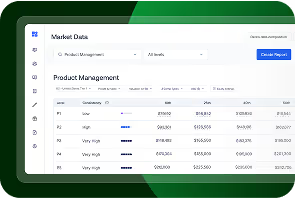
An important aspect that's often overlooked is the foundation of this policy. Lovable's Chief People Officer told CNBC that the company uses Pave data to benchmark pay at the 90th percentile by role and location. And this data is not used solely for annual salary adjustments.
Lovable conducts quarterly performance check-ins, biannual salary reviews for promotions and scope changes, and ongoing pay equity audits across regions. The anniversary raise is one component of a broader system where market data informs every compensation decision throughout the employee lifecycle.
This distinguishes companies that merely benchmark from those that operationalize their data. Effective organizations use real-time compensation data to identify attrition risks, monitor market shifts, and address issues before they impact turnover. Lovable's CPO emphasized that this is a proactive approach to retention.
When Competing for Critical Talent, Differentiation Matters
The current AI talent market is highly competitive. Major technology companies and fast-growing startups are competing for the same candidates. In this environment, simply matching market rates is not enough. Employers must provide compelling reasons for candidates to choose and remain with them.
Lovable's policy sets the company apart by offering immediate, tangible rewards. While many startups focus on equity with four-year vesting schedules, Lovable provides predictable cash increases. This approach communicates that employees are valued in the present, not only at a future liquidity event.
This policy has received significant media coverage from outlets such as CNBC, TechCrunch, Sifted, and Entrepreneur. Each article enhances Lovable's employment brand and supports talent acquisition. Differentiating on compensation attracts attention in the labor market and draws top candidates to the company.
A word of caution: the simplicity of Lovable's approach is part of what makes it appealing, but it also runs counter to the direction many organizations are heading. The broader trend in comp right now is toward pay-for-performance, tying increases more tightly to individual output and impact rather than tenure alone. A blanket anniversary raise is a clean, easy-to-communicate policy, but it's not the right fit for every company. Before adopting any program like this, you should always evaluate how it aligns with your company's culture, what it signals to your highest performers, and whether your organization’s financials can sustain it at scale.
What This Means for Your Comp Strategy
You don't need to replicate Lovable's approach exactly. However, the underlying principles are valuable: base compensation decisions on real market data, use compensation proactively to retain employees, and seek unique opportunities to differentiate your organization and employee value proposition.
The key takeaway is that attracting and retaining talent is not solely about increasing spending. It requires clarity, intentionality, and transparency in your compensation strategy so employees understand why they should remain with your organization.

Charles is a member of Pave's marketing team, bringing nearly 20 years of experience in HR strategy and technology. Prior to Pave, he advised CHROs and other HR leaders at CEB (now Gartner's HR Practice), supported benefits research initiatives at Scoop Technologies, and, most recently, led SoFi's employee benefits business, SoFi at Work. A passionate advocate for talent innovation, Charles is known for championing data-driven HR solutions.
Frequently Asked Questions:
What is Lovable's 10% raise policy?
Lovable, a Stockholm-based AI startup, guarantees every full-time employee a 10% salary increase on their work anniversary. The policy is designed to reward retention and remove the need for employees to negotiate raises through traditional review cycles.
What compensation data does Lovable use?
Lovable uses Pave's real-time compensation data to benchmark employee pay at the 90th percentile of market value by role and location, layering the anniversary raise on top of quarterly and biannual comp reviews.
Why is Lovable giving automatic raises instead of performance-based raises?
Lovable's leadership believes that employees compound in value the longer they stay and that compensation should automatically reflect that. The 10% raise is a floor, not a ceiling — high performers and promoted employees can still earn additional increases through Lovable's biannual salary reviews.
How does Lovable's raise compare to average wage growth?
ADP data from April 2026 show that U.S. workers who stayed in their jobs saw 4.4% year-over-year wage growth, while job switchers saw 6.6%. Lovable's guaranteed 10% anniversary raise significantly outpaces both benchmarks.
How does Pave help companies like Lovable set compensation?
Pave is a compensation platform that provides real-time market benchmarking data by role and location. Companies like Lovable use Pave to inform pay decisions, run equity audits, and build comp strategies grounded in current market data rather than outdated surveys.