
Key Takeaways
- Average bonus percentages in tech range from 10% at the professional level to 25% or more at senior and management levels, based on Pave's compensation benchmarking data
- Formal bonus plans are the dominant short-term incentive structure in tech, but eligibility is far from universal, particularly at private companies
- Most tech companies layer multiple bonus types together, and understanding how each one works is the starting point for designing a program that holds up
- Public and private companies differ significantly in how broadly they extend bonus eligibility, especially below the management level
Bonus percentage is among the first numbers a candidate asks about, but can be one of the hardest for compensation teams to answer with confidence. Not because the data does not exist, but because the question itself is quite nuanced.
The average bonus percentage in tech is not a single number. It shifts by level, by company type, and by the program's structure. A professional-level engineer and a VP at the same company can have targets that differ by 15 percentage points. Whether those employees receive a bonus often depends more on the company's maturity than on their role.
What Drives Bonus Percentage in Tech
Three factors consistently shape how tech companies set bonus percentages.
- Level and scope. Bonus targets scale with seniority, both as a performance incentive and a retention signal. The gap between entry-level and senior targets is wider than most compensation teams expect when they first review market data.
- Company type. Public tech companies formalize bonus structures earlier and extend them more broadly than private ones. That difference shows up not just in bonus size, but in who is eligible at all.
- Program design. Formal plans, discretionary bonuses, and spot bonuses serve different purposes and are typically layered together. The mix a company chooses reflects how mature its compensation philosophy actually is.
Types of Bonuses Tech Employees Receive
Not all bonuses in tech work the same way. Each serves a different function, and most tech companies use more than one at a time.
- Formal bonus plans tie payouts to predefined performance metrics, such as revenue targets, project milestones, or operational goals, and are paid on a set schedule, typically annually. They provide the clearest connection between performance and reward.
- Discretionary bonuses are determined at the manager's or the company's judgment, with less formal criteria. The flexibility is useful, but without guardrails, discretionary programs introduce inconsistency that compounds over time. They tend to work best as a complement to a formal plan.
- Spot bonuses are one-time awards given to recognize a specific contribution that falls outside the normal review cycle. In tech, spot bonuses appear across every level and every company type. In many cases, spot bonuses fill recognition gaps that annual cycles aren't designed to address.
Pave's Pulse Survey data shows how short-term incentive programs are distributed across levels at public and private tech companies.
At the professional level (P1–P6), formal bonus plans are the most common structure, offered by 73.7% of public companies and 43.9% of private companies. Spot bonuses are also widely used (31.6% public, 32.7% private). A meaningful portion of companies do not extend short-term incentives to professional-level employees at all: 13.2% of public companies and 21.4% of private companies.
At the management level (M3–M6), formal plan adoption increases substantially. Among public companies, 89.5% offer formal plans to managers. Among private companies, 58.2% do. Eligibility exclusions narrow here as well: 12.2% of private companies exclude managers from short-term incentives, compared to 7.9% of public companies.
At the VP level, formal bonus plans are nearly universal at public companies (94.7%) and highly prevalent at private companies (75.5%). Discretionary and spot bonuses still appear at this level, but as supplements to formal plans.
Public companies standardize bonus programs earlier and more consistently. Private companies exhibit greater variation, particularly at the professional level, where nearly one in five companies offers no access to short-term incentives at all. And as the level increases, the share of employees excluded from any short-term incentive approaches zero.
Average Bonus Percentages in Tech by Level
The table below shows target bonus percentages for software engineers in the United States, one of the largest and most consistently benchmarked populations in tech, based on data from Pave's compensation intelligence platform.
P1 and P2 targets cluster tightly around 10%, reflecting how tightly clustered entry-level bonus targets are across the market. That changes at P3, where the 75th percentile jumps to 15% and continues to widen through P5 and P6. By P5, the median target is 20%. Companies competing for senior individual contributors are using bonus targets as a differentiation point, not a formality.
M3 targets align with P3 and P4 engineers, but the trajectory steepens quickly. M6 managers at the 75th percentile are targeting 30%, a range that reflects executive-level compensation philosophy rather than individual contributor norms.
A company at the 25th percentile for P6 bonuses (18%) versus one at the 75th (25%) is making a deliberate statement about how much of total compensation it loads into variable pay. Neither position is wrong, but both require a clear rationale when the conversation surfaces during a review cycle or a competing offer.
How to Put This Data to Work
Benchmarking bonus percentages is about making intentional decisions and being able to explain them, not landing on the median.
Level-by-level benchmarks give compensation teams a foundation for setting targets that reflect market positioning and internal equity. When employees understand where their target sits in the market and what performance metrics determine the final payout, compensation conversations become less subjective and more productive.
A tech company that covers VP-level employees with formal plans while excluding professional-level contributors from short-term incentives entirely is making a positioning choice that may surface in retention conversations. That gap surfaces at the worst possible moment: a retention conversation, a competing offer, or a compensation planning cycle that produces more attrition than expected.
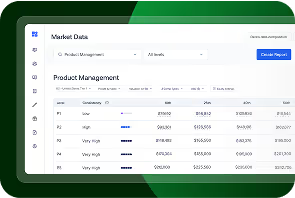
In Pave, compensation teams can benchmark bonus percentages in real time using data from thousands of companies, filtered by level, geography, and company type.
From Benchmarks to Better Bonus Decisions
Designing a competitive bonus structure in tech starts with knowing what the market actually pays, across levels, company types, and program structures. Pave's compensation intelligence platform gives compensation teams the real-time benchmarks to make those decisions with confidence. Explore Pave's Market Data.

Pave is a world-class team committed to unlocking a labor market built on trust. Our mission is to build confidence in every compensation decision.
Frequently Asked Questions
What is the average bonus percentage in tech?
It varies by level and company type. Median bonus targets for software engineers are around 10% at the professional level and 20% at the senior level, based on Pave's compensation benchmarking data. At the management level, median targets range from 15% at M3 to 25% at M6.
What types of bonuses are most common in tech?
Formal bonus plans are the most widely used structure, particularly at public tech companies. Spot bonuses are common across all levels and company types. Discretionary bonuses are more prevalent at private companies, where formal structures are less consistently adopted.
Do all tech employees receive a bonus?
Not always. Pave's Pulse Survey data shows that 13.2% of public companies and 21.4% of private companies do not offer short-term incentives to professional-level employees. Eligibility increases with seniority. Most VP-level employees are covered by a formal plan, while support-level employees are the most frequently excluded.
How do public and private tech company bonus structures differ?
Public companies formalize bonus programs earlier and extend them more broadly across levels. At the professional level, 73.7% of public companies offer formal bonus plans, compared to 43.9% of private companies. Private companies exhibit greater variation in both structure and eligibility, particularly at lower levels of management. The gap narrows at the VP level, where formal plans are nearly universal across both company types.
How should compensation teams benchmark bonuses in tech?
Benchmark by level using real-time market data, not static survey cycles. Teams working from data that is even one cycle old risk making decisions that are already out of step. Pave's platform allows compensation teams to benchmark bonus targets by level and company type, track market trends, and build programs that stay competitive as conditions evolve.