.avif)
Key Takeaways
- CRO compensation should balance stability and upside, base salary for predictability, variable pay for performance, and equity for the long game.
- The plan must align with company priorities, including ARR growth, retention, and margin discipline.
- Performance inputs such as forecasting accuracy and pipeline quality are as important as revenue outcomes.
- Equity is a critical lever, often representing the largest long-term value driver in compensation for Chief Revenue Officers.
- Strong plans are simple, transparent, and supported by clear governance to prevent misalignment and risk.
A chief revenue officer sits at the intersection of strategy and execution, responsible not just for closing deals, but for how the entire revenue engine performs. So how do you pay for that?
Most CRO compensation plans combine a fixed base salary, a performance bonus tied to ARR growth and retention, and equity that rewards long-term company value creation. Getting the balance right between those three components determines whether the plan motivates the right behavior or creates the wrong ones.
Understanding the CRO Role
The CRO operates across the entire revenue engine, not just the close. This includes new business acquisition, expansion, renewals, and in many organizations, pricing and go-to-market strategy. Unlike a VP of Sales, who focuses primarily on bookings, the CRO is accountable for how revenue is generated, forecasted, and retained.
The scope of the role expands significantly with company scale. In earlier-stage companies, the CRO may still operate close to execution. At later stages, the role shifts toward strategy, with responsibility for multi-layered teams and board-level reporting. That variability has direct implications for pay structure: a CRO overseeing a complex revenue organization carries both higher impact and higher risk, and compensation should reflect that—typically through a higher variable ceiling and a larger equity component rather than base salary alone.
Core Components of CRO Compensation
Every CRO compensation plan has three building blocks.
Base salary provides stability and reflects market value. For most CROs, the base covers core financial needs without depending on performance outcomes.
Variable pay creates performance alignment. It typically includes incentives tied to revenue outcomes, but increasingly incorporates operational metrics such as pipeline quality and forecast accuracy.
Equity builds long-term ownership. Stock options or RSUs align the CRO with company value creation over multiple years and often represent the largest share of upside in high-growth environments.
Most organizations structure CRO compensation with the majority of pay in base salary and a meaningful variable component at target, with additional upside through accelerators and equity appreciation. As the role expands in scope, variable pay is increasingly tied to multiple performance inputs rather than a single revenue target, reflecting the CRO's accountability across the full revenue engine, not just bookings.
Benchmark Base Salary by Industry
Without market context, compensation decisions become guesswork. Base salary for a CRO varies significantly by company stage, industry, and the complexity of the revenue organization the role oversees.
Industry also matters. SaaS and high-growth sectors often offer lower base salaries with higher equity upside, while regulated industries such as financial services tend to offer higher base compensation due to longer sales cycles and complexity.
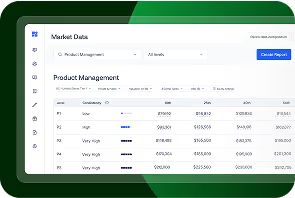
Static benchmarks are increasingly insufficient. Companies that rely on annual survey data risk calibrating against market conditions that no longer exist, particularly for executive roles where scope and demand shift quickly. Pave’s Market Data Pro gives teams the real-time benchmarks needed to make those calibrations with confidence.
Designing the Variable Compensation Plan
Variable pay is where you shape behavior. A well-designed bonus plan motivates the CRO to hit targets that matter while discouraging shortcuts that hurt the business.
The structure of the plan matters as much as the metrics it tracks. WorldatWork research on sales leader incentive design shows that larger organizations typically place revenue leaders on executive bonus plans rather than traditional sales compensation plans, because their accountability extends well beyond direct bookings.
Common performance metrics include ARR or revenue attainment, net revenue retention, forecast accuracy, pipeline coverage and quality, and gross margin. The weighting of these metrics signals what the organization values. A plan weighted heavily toward ARR attainment will prioritize growth, while adding margin and retention metrics introduces discipline around how that growth is achieved.
Strong plans also include clear attainment thresholds, accelerators for overperformance, and guardrails to prevent behavior such as excessive discounting. The goal is not just to reward revenue, but to reward sustainable, predictable revenue.
Aligning Compensation With Revenue Strategy
A CRO compensation plan should reinforce the company's revenue strategy, not work against it.
If growth is the priority, incentives should emphasize new ARR. If retention and expansion are critical, net revenue retention and customer health metrics should carry more weight. If profitability is under pressure, margin must be part of the equation.
Misalignment creates predictable problems. Rewarding bookings without margin controls drives discounting. Penalizing forecast misses too aggressively leads to sandbagging. The most effective plans create cascading alignment, where CRO incentives match executive priorities and connect directly to how the broader revenue team is compensated. That alignment should be reviewed regularly, because as strategy shifts, static plans lose effectiveness.
Governance and Plan Design Discipline
Well-designed plans can still fail without clear governance. CRO plans should include defined crediting rules, clear treatment of territory or account changes, clawback provisions where appropriate, and documented payout mechanics.
Note on clawbacks: under SEC Rule 10D-1, public companies listed on NYSE and Nasdaq are required to maintain policies for recovering incentive-based compensation tied to financial restatements. Even private companies not subject to this rule benefit from building clawback language into executive agreements as a standard governance practice. That said, it’s always advised to consult legal counsel rather than relying on this description alone.
Simplicity matters throughout. Complex plans introduce ambiguity, which weakens trust and reduces effectiveness. Building compensation controls into your process from the start is far easier than correcting for drift after the fact. It is also worth pressure-testing your plan design against common executive compensation mistakes before finalizing. The most avoidable problems tend to stem from plans that are too complex, too heavily tied to a single metric, or lacking clear governance from the outset.
Build a Compensation System That Scales
A CRO compensation plan is not just an offer. It is a system that shapes how revenue decisions get made. When designed well, it aligns leadership behavior with company outcomes, reinforces accountability, and scales as the organization grows.
With real-time market data, job pricing workflows, and integrated compensation planning from Pave, teams can design Chief Revenue Officer compensation plans that stay competitive, aligned, and defensible as conditions evolve.

Pave is a world-class team committed to unlocking a labor market built on trust. Our mission is to build confidence in every compensation decision.
Frequently Asked Questions (FAQ)
What is the right pay mix for a CRO compensation plan?
Most organizations structure CRO compensation with the majority of pay in base salary and a meaningful variable component at target, with additional upside through accelerators and equity. The right mix depends on the company's stage, revenue predictability, and risk tolerance. Earlier-stage companies often lean more heavily on variable and equity, while later-stage companies prioritize stability.
Which metrics should CRO compensation be tied to?
CRO compensation should balance growth and quality of revenue. Common metrics include ARR attainment, net revenue retention, and forecast accuracy. Leading organizations also incorporate pipeline health and gross margin to prevent misaligned behaviors such as over-discounting.
How should equity be structured for CROs?
Equity should align the CRO with long-term company performance while remaining competitive with market expectations. Most plans use a mix of time-based vesting and, increasingly, performance-based equity tied to revenue or valuation milestones.
How often should a CRO compensation plan be reviewed or updated?
CRO plans should be reviewed at least annually, with lighter calibration during quarterly business reviews. As market conditions, growth targets, or company strategy shift, compensation structures should be adjusted to maintain alignment and competitiveness.
.avif)