Compensation leaders have always known that not all benchmarks are created equal.
Filtering by industry, size, and stage gets you in the right neighborhood—but it doesn't tell you what your specific talent competitors are paying. When you're competing head-to-head with a known set of companies for the same engineers, salespeople, and product managers, you need a benchmark that reflects that reality.
That's why we're launching Peer Groups in Market Data Pro—the ability to define a curated set of companies and benchmark compensation directly against them.
But peer benchmarking creates a real tension. The more specific a benchmark is, the greater the risk that individual company data can be inferred. Traditional survey providers have struggled with this tradeoff for decades, often choosing between usefulness and privacy.
We didn't want to make that choice. We built Peer Groups on top of Pave's existing multi-layered privacy framework, adding protections purpose-built for named peer groups.
Why Peer Groups Matter Now
If you've ever tried to answer "Are we competitive with our top five talent competitors?" using broad market filters, you know the frustration. Filters are great for exploration, but they can't deliver the targeted view you need for setting compensation philosophy, planning budgets, making executive offers, or preparing board materials.
For public companies, this need is even more urgent. SEC Pay Versus Performance disclosure requirements now mandate reporting executive compensation relative to peer total shareholder return—an ad hoc filtering approach simply doesn't hold up to governance and investor scrutiny.
Peer Groups give private companies the strategic precision they've been asking for, and public companies the defensible, auditable peer sets that compliance requires.
How Peer Groups Work
- Define your peer group. Select the companies you compete with for talent. Build multiple groups for different purposes—engineering roles, executive compensation, board reporting.
- Validate data availability. Before you lock your group, Pave shows you benchmark coverage across your selections so you can confirm useful data exists for the roles you care about.
- Benchmark with one click. Your saved peer group becomes a persistent filter you can apply instantly. No more rebuilding filter combinations every time.
- Maintain and refine. Peer groups can be updated every six months—stable enough for consistent decisions, flexible enough to evolve with your business.
The Hard Problem: Privacy in Targeted Benchmarks
When you narrow a benchmark from "200+ employee Series B SaaS companies" to "my 15 named talent competitors," the privacy challenge changes completely; fewer companies mean higher risk that a knowledgeable user could infer something about a specific competitor's pay practices.
Pave's Market Data product is designed to help you understand the compensation market, not expose any individual company's pay strategy. That principle applies to peer groups as well.
Multi-Layered Privacy Protections
Minimum company thresholds. Every benchmark requires a minimum number of contributing companies. If a peer group segment doesn't meet the threshold, no data is shown—no exceptions.
Adaptive data dominance controls. We cap each company's contribution so that no organization can account for 50% or more of the underlying data. This is enforced at every level of aggregation and can't be circumvented through creative filtering.
Company-level anonymity. We never reveal which companies contribute to any given benchmark segment. Even within a peer group, you cannot determine whether a particular company has employees in a specific role, attribute benchmark movements to a competitor's actions, or use Pave for targeted competitive intelligence.
Monthly batch updates. All changes from all companies are bundled in a single monthly release. Any benchmark movement reflects the combined actions of all participants—new hires, terminations, promotions, and compensation adjustments—making it impossible to isolate a single company's actions.
Statistical aggregation. Benchmarks display percentile distributions (e.g., 25th, 50th, 75th) with sample-size transparency and a consistency score, providing market insights without exposing individual data points.
Peer Groups vs. Market Filters
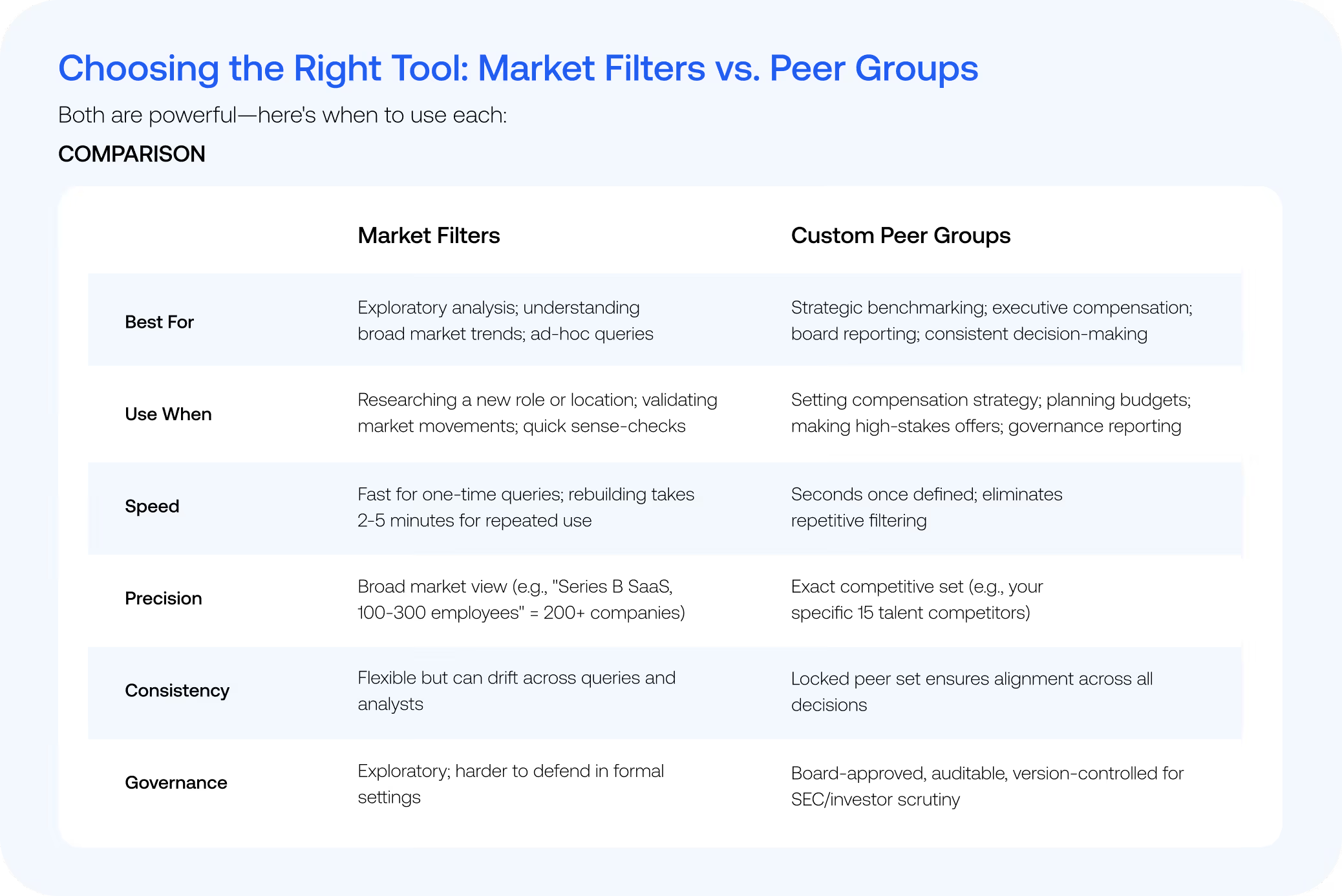
These tools are complementary. Market filters remain ideal for exploratory analysis, researching new roles or locations, and quick sense-checks. Peer Groups are the right tool when you need strategic precision: setting philosophy, planning budgets, making high-stakes offers, and preparing board materials.
The best compensation teams will use both. Start with filters to understand the landscape, then apply your peer group for the decisions that require the most precision.
When Precision Pays
Market filters give you the broad view. Peer Groups give you a targeted one. Together, they make Market Data Pro a more powerful compensation benchmarking toolkit—backed by the same multi-layered protections trusted by over 8,700 companies.
Now you can understand the full market and zoom in on the competitors that matter most, all without compromising the privacy of any participating company.
Ready to benchmark against the companies that actually matter? Book a demo of Market Data Pro today.

Charles is a member of Pave's marketing team, bringing nearly 20 years of experience in HR strategy and technology. Prior to Pave, he advised CHROs and other HR leaders at CEB (now Gartner's HR Practice), supported benefits research initiatives at Scoop Technologies, and, most recently, led SoFi's employee benefits business, SoFi at Work. A passionate advocate for talent innovation, Charles is known for championing data-driven HR solutions.
What are Peer Groups in Pave?
Peer Groups let you select a curated set of companies and benchmark compensation directly against them. Instead of filtering by broad attributes such as industry or company size, you define the specific organizations you compete with for talent and receive benchmarks tailored to that competitive set.
How are Peer Groups different from market filters?
Market filters provide a broad view of compensation trends across companies, allowing you to match criteria such as stage, size, and industry. Peer Groups give you a targeted view of the specific companies you've selected. Filters are ideal for exploratory research; Peer Groups are built for strategic decisions, budget planning, and board reporting. Most teams use both.
How does Pave protect company data in Peer Groups?
Pave applies multiple layers of privacy protection to every benchmark, including Peer Groups. These include minimum company thresholds, adaptive data dominance controls that prevent any single company from representing 50% or more of a benchmark, company-level anonymity so you never see which companies contributed to a specific segment, and monthly batch updates that bundle all changes together.
Can a company's compensation data be reverse-engineered from a Peer Group benchmark?
No. Even within a small peer group, Pave's layered controls work together to prevent this. Dominance caps ensure no single company can skew results, company-level anonymity means you can't confirm whether a specific peer contributed data to a given segment, and monthly batching makes it impossible to attribute benchmark movements to any one company's actions.
Can Peer Groups support SEC Pay Versus Performance reporting?
Peer Groups are versioned, auditable, and consistently applied across all benchmark queries—qualities that lend themselves well to governance use cases. That said, PvP disclosure requirements vary, so we recommend working with your legal counsel and investor relations team to determine how Peer Groups best fit into your reporting process.
What happens if my Peer Group doesn't have enough data for a specific role?
If a segment within your Peer Group doesn't meet Pave's minimum company threshold, no benchmark is displayed for that segment. Pave never relaxes its privacy controls to fill gaps. You can verify data availability before locking your Peer Group to avoid surprises.
How often can I update my Peer Group?
Peer Groups can be updated every six months. This keeps your competitive set stable enough for consistent decision-making while giving you the flexibility to adjust as your talent market evolves.